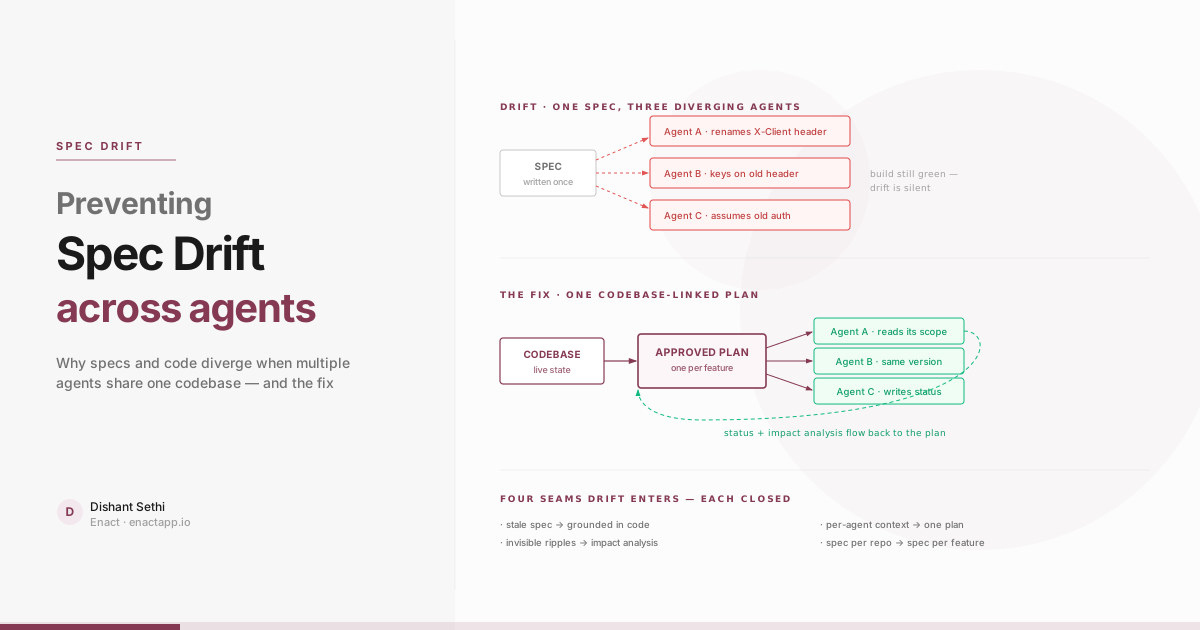
Learning how to prevent spec drift is critical when multiple AI coding agents operate concurrently within the same codebase. Imagine two AI coding agents executing tasks in the same repository on the same morning. One agent adds sliding-window rate limiting to public endpoints, while the second refactors authentication middleware governing those exact routes. Both agents possess valid specifications. However, neither specification accounts for the other's concurrent modifications.
By the time pull requests are merged, the rate limiter depends on an HTTP header that the authentication refactor just renamed. The original specification that should have prevented this regression still documents the obsolete header name.
This failure mode is spec drift: the subtle divergence between what an approved specification describes and what code actually implements. When teams scale autonomous agents, this divergence accelerates rapidly.
Key Takeaways
- Compounding divergence: Spec drift represents the expanding gulf between approved design specifications and deployed source code, compounding when multiple autonomous agents commit code in parallel.
- The hazard of silent drift: Unlike compiler errors or failing unit tests, spec drift is silent. Pull requests pass continuous integration checks while introducing architectural divergence that only surfaces during production incidents.
- Four operational seams: Drift originates from four failure points: static one-time specifications, isolated agent context windows, unmapped cross-cutting modifications, and specifications fragmented across microservice repositories.
- Structural prevention: Discipline alone cannot solve silent drift. Prevention requires structural infrastructure: an authoritative specification grounded in live codebase syntax trees, read by all agents via the Model Context Protocol (MCP).
What is spec drift?
To prevent spec drift, engineering teams must define it with precision: spec drift is the widening gap between the system design a team signed off on and the software that actually runs in production. Over time, the specification ceases to reflect operational reality.
In academic software engineering research, this phenomenon is categorized as silent spec-code drift, where implementation evolves while formal specifications remain static. Because the discrepancy goes unnoticed until refactoring becomes prohibitive, architectural debt accumulates invisibly.
Workflow summary: Static specifications remain fixed while autonomous agents push continuous code updates, resulting in silent architectural drift.
The silence of drift is what makes it dangerous. When a test suite fails, CI blocks the deployment. Spec drift triggers no compiler warnings. The build succeeds, code diffs look clean in isolation, and the specification in Jira or Markdown remains exactly as written weeks earlier.
On a solo project, an individual developer can mitigate drift because they hold both intent and implementation in memory. However, that assumption breaks down immediately in team environments.
Why multiple agents accelerate spec drift
When multiple autonomous agents edit a repository simultaneously, drift accelerates because each agent operates on an isolated context window. Every code generation cycle introduces a fresh opportunity for implementation details to wander from intended architecture.
A human engineer modifying code remembers recent changes made across neighboring files. AI coding assistants retain zero persistent memory across distinct sessions, and parallel agents share no intermediate state. When Agent A renames a database column or deprecates a utility function, Agent B continues building against the snapshot it ingested when its task began.
Workflow summary: Autonomous agents working in parallel from isolated context windows create conflicting implementations that break at integration boundaries.
Empirical research confirms the frequency of these integration failures. In an analysis of 600 rejected agent-authored pull requests on GitHub, researchers found agent misalignment, where assistants implement solutions adjacent to actual system requirements, to be a primary reason for rejection. Scaling multiple agents across an uncoordinated codebase transforms isolated pull request rejections into systemic architectural instability.
The four structural seams where drift occurs
Spec drift is not a singular bug; it enters software architectures through four distinct seams:
1. Static specifications written once
Most specifications function as ephemeral kickoff documents. Once coding begins, no automated mechanism verifies that subsequent commits honor original constraints. The specification gradually becomes fiction while agents continue treating it as truth.
2. Isolated agent context windows
Each coding assistant observes only the explicit prompt and file context loaded into its active session. An agent lacks awareness of organizational standards or concurrent pull requests, resulting in locally logical but globally conflicting implementations.
3. Invisible cross-cutting changes
Renaming an API parameter, altering an error payload structure, or modifying authorization scopes creates ripples across downstream services. Because agents lack cross-repository dependency graphs, these blast radiuses remain invisible until staging tests fail.
4. Per-repository specification silos
When features span frontend clients, backend APIs, and background workers, teams frequently split requirements into separate markdown files per repository. Without continuous synchronization, these siloed documents drift apart, introducing breaking contract discrepancies.
Workflow summary: Fracturing feature requirements across repository boundaries guarantees cross-service contract discrepancies.
Structural mechanisms to prevent spec drift
Preventing spec drift requires structural infrastructure rather than manual discipline. Teams must implement controls that automatically expose discrepancies between specifications and code before pull requests are merged.
Workflow summary: Grounding a unified specification in live codebase syntax trees ensures parallel agents operate against consistent architectural constraints.
1. Ground specifications in live codebase syntax trees
Specifications must be validated against the active codebase using tree-sitter parsers (incremental abstract syntax tree analyzers) rather than human memory. By verifying that referenced data models, endpoints, and utilities exist in real code, teams eliminate hallucinated dependencies before implementation starts. Platforms like Enact anchor specifications directly to live repository graphs.
2. Serve one authoritative plan to all agents
Rather than letting agents ingest fragmented local instructions, teams must establish a single authoritative plan delivered via the Model Context Protocol (MCP). Each assistant queries the unified specification dynamically, ensuring all concurrent workers share consistent requirements.
3. Conduct multi-repo impact analysis before coding
Before an agent renames a parameter or alters a schema, automated impact analysis must identify all downstream consumers across every repository. Exposing this blast radius upfront prevents cross-repo contract regressions. For deeper analysis, explore our guide on AI coding agents in multi-repo codebases.
4. Maintain feature-level specifications
Requirements that span multiple services must reside in a unified feature specification rather than separate per-repo files. When an API contract updates, frontend and backend agents consume the modification simultaneously from the same approved record.
Practical team checklist for preventing drift
Engineering organizations can eliminate spec drift systematically using this prioritized verification checklist:
| Operational Check | Architectural Seam Closed |
|---|---|
| Live codebase grounding | Prevents specifications from referencing deprecated functions or obsolete schemas |
| Unified feature-level spec | Eliminates contract divergence between frontend and backend repositories |
| Dynamic MCP plan injection | Ensures all concurrent agents execute from the same version-locked instructions |
| Pre-build blast radius mapping | Surfaces cross-service dependencies before schema modifications are implemented |
| Bidirectional agent reporting | Captures execution blockers and task completion back into the plan in real time |
| Immutable approval sign-offs | Establishes an unalterable architectural baseline via a spec approval workflow |
Enforcing these safeguards allows organizations to scale concurrent coding assistants without increasing architectural risk. Teams can quantify the productivity savings of eliminating rework cycles using our rework ROI calculator.
Keep one approved plan true across every agent
See how Enact grounds specifications in live code, performs multi-repo impact analysis, and keeps agents synchronized across services.
Explore Enact →