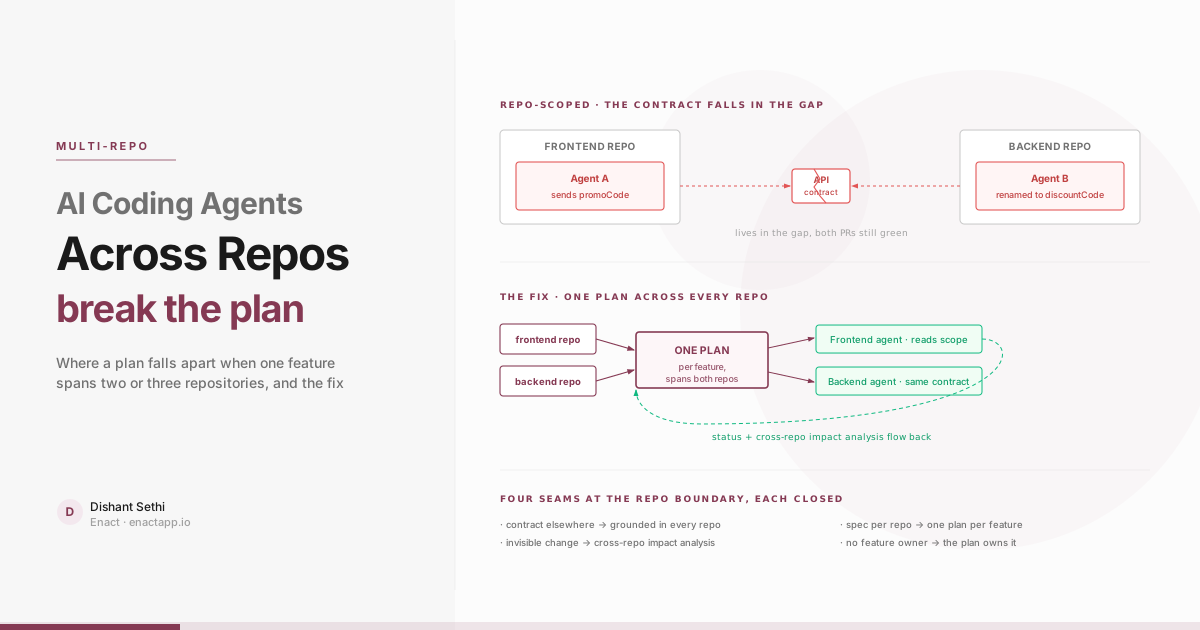
Deploying ai coding in multi repo codebases introduces a subtle architectural vulnerability: each agent reasons effectively within its local repository, but integration contracts fall into the unmapped gap between repositories. Consider a common microservice scenario: a frontend AI coding assistant updates a checkout modal to include a new promoCode payload parameter. The specification provided to the frontend agent indicates the payment service accepts this field.
However, in a separate backend repository, a second AI coding agent refactored that endpoint two days prior, renaming the parameter to discountCode. Both pull requests pass local unit tests. Both specifications appear complete in isolation. The integration breaks only in staging when promotional discounts fail to apply.
Neither agent hallucinated. This breakdown is the signature failure mode of multi-repo agentic architectures: each assistant executed tasks accurately within its repository boundary, while the shared API contract between services went unverified.
Key Takeaways
- Repository boundaries limit context: AI coding assistants are engineered around single repository checkouts where syntax trees, package dependencies, and test runners reside within one directory root.
- Contracts fall into the gap: Modern enterprise features cross microservice boundaries. When specifications are maintained per repository, cross-service API contracts and data transfer objects (DTOs) lack an authoritative single source of truth.
- Context window expansion is insufficient: Simply loading multiple codebases into an expanded prompt window creates noise and dilution without establishing contract enforcement or decision governance.
- Unified feature-level planning: Coordinating agents across distributed repositories requires a single feature-level specification grounded in structural codebase knowledge graphs and served via the Model Context Protocol (MCP).
Why the repository boundary limits agent intelligence
AI coding assistants operate efficiently within single repositories because a repository represents a coherent, self-contained unit of execution. The model indexes source files, resolves internal module imports, executes local test suites, and verifies compilation within a single workspace.
Multi-repo architectures break these local assumptions. Features frequently span a web client, an API gateway, background workers, and shared database models. Because developer tooling isolates agents to the active working directory, the assistant cannot inspect service definitions residing in neighboring repositories.
As highlighted in GitHub community discussions regarding Copilot multi-repo limitations, developers frequently note that coding assistants cannot reason about contracts or Data Transfer Objects (DTOs) defined in separate repositories. A frontend agent has no native mechanism to verify whether an API schema in the backend repository changed.
Workflow summary: Isolated coding agents understand their local repository completely, but cross-service API contracts fall into the uncoordinated gap between repositories.
Within each local repository, the agent has complete visibility. Between repositories, neither agent has systemic context. The shared schema binding services together is precisely what neither assistant inspects.
Four failure points in multi-repo agentic architectures
Multi-repo planning failures follow four distinct patterns across enterprise codebases:
Workflow summary: Fragmenting specifications across repositories creates conflicting API schemas that pass isolated continuous integration but fail during runtime integration.
1. API contracts defined in remote repositories
A frontend application consumes an endpoint whose authoritative schema is defined in a backend service. When the backend agent updates a field name, status code, or authentication header, the frontend assistant continues generating code against cached assumptions. The shared API contract remains unvalidated.
2. Specifications scoped per repository instead of per feature
When features span multiple services, teams often author separate specifications within each repository (such as local SPEC.md files). Without automated synchronization, these documents drift independently. This represents the cross-repository manifestation of spec drift, compounded because changes cross organizational team boundaries.
3. Invisible downstream blast radiuses
When an agent renames a parameter or alters database serialization in a core microservice, the impact ripples across multiple consumer repositories. Inside the origin repository, test suites pass. Across repository boundaries, downstream services break without warning.
4. Fragmented feature ownership
When separate agents implement isolated slices of a feature across different repositories, no single agent is accountable for the end-to-end user journey. Both assistants mark their tickets as resolved, leaving integration verification to manual staging audits.
Why larger context windows cannot solve multi-repo fragmentation
Increasing the context window of foundation models appears to be an intuitive fix, but it fails to address structural coordination.
Loading multiple entire repositories into an active prompt window introduces severe signal-to-noise degradation. Model attention degrades across hundreds of thousands of irrelevant code tokens, increasing hallucination rates and execution latency. Furthermore, loading raw source code forces the model to reverse-engineer architectural relationships on every prompt, rather than adhering to an approved contract.
Maintaining synchronization across distributed microservices requires formal architectural definitions and contract testing, as established by Martin Fowler's microservice testing principles. Coordinating distributed services requires shared, version-controlled specifications, not unbounded prompt contexts.
Structural architecture for multi-repo coordination
Aligning AI coding assistants across microservices requires structural planning infrastructure rather than ad-hoc prompting:
Workflow summary: A unified feature plan grounded in cross-repository abstract syntax trees ensures frontend and backend agents adhere to synchronized contracts.
1. Ground specifications across all repositories simultaneously
Specifications must be validated against the live syntax trees of every affected service before implementation begins. Using tree-sitter parsers (incremental abstract syntax tree analyzers), platforms like Enact index dependencies, shared schemas, and API routes across all repositories, ensuring specifications reflect current system state.
2. Author one specification per feature, not per repository
Features that touch multiple microservices must be defined in a unified feature specification. The specification explicitly defines the shared data payload, the backend consumer, and the frontend client, preventing contract divergence before coding starts.
3. Perform cross-repo impact analysis before code generation
Before an agent modifies a schema, automated impact analysis should identify all downstream callers across connected repositories. Exposing this blast radius upfront allows developers to update all affected services concurrently.
4. Deliver specifications dynamically over MCP
Rather than manually copying markdown files across repositories, teams serve frozen, approved specifications directly to Cursor, Claude Code, and Copilot via the Model Context Protocol (MCP). Each assistant consumes the unified specification, and reports status back to the central plan.
This cross-repository coordination is a cornerstone of the agentic SDLC, ensuring autonomous agents execute within verified boundaries.
Practical checklist for multi-repo engineering teams
Engineering organizations managing distributed microservices can adopt multi-repo agentic workflows using this checklist:
| Operational Check | Coordination Vulnerability Addressed |
|---|---|
| Multi-repo AST grounding | Prevents agents from guessing remote schema structures |
| Unified feature-level spec | Eliminates contract discrepancies between frontend and backend repos |
| Pre-code blast radius analysis | Identifies downstream consumer services before schema changes are merged |
| Centralized MCP delivery | Ensures all agents operate from an identical, version-locked specification |
| Bidirectional status synchronization | Assigns end-to-end integration accountability to the central plan |
| Joint stakeholder sign-off | Verifies technical feasibility via a structured spec approval workflow |
Implementing these safeguards enables teams to run multiple agents in parallel across repositories without accumulating integration debt. Teams can estimate the financial cost of multi-repo rework cycles using our rework ROI calculator.
See how Enact plans across every repo your agents touch
Bring a feature spanning multiple services. We will show you how Enact grounds unified plans in all of them and maintains contract synchronization.
Book a call →