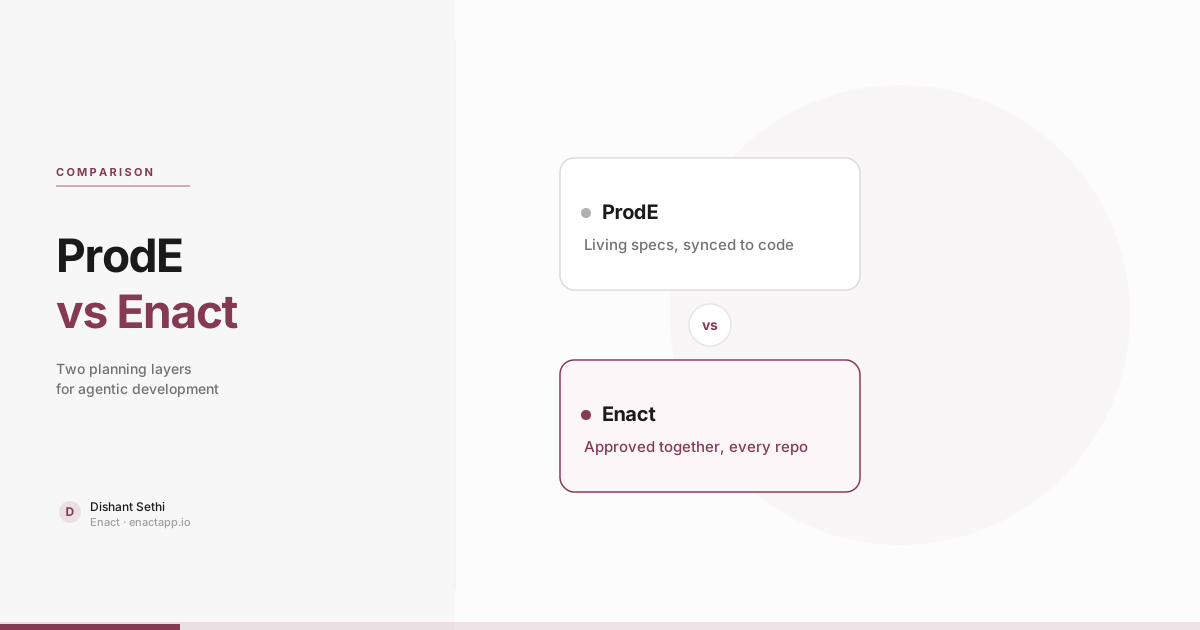
ProdE and Enact start from almost the same sentence. ProdE's homepage calls itself "Software Planning for Agentic Development" — the exact category Enact works in — and leads with "We turn your ideas into Claude Code ready specs." When two tools describe themselves this closely, the interesting question is not which one "does planning," but where each one decides the hard part actually lives.
ProdE is a real product, and the fair point of comparison. Enact is the ProdE alternative built for teams whose planning has to follow their own workflow. Both put a codebase-aware plan in front of a coding agent before it builds. They diverge on what the plan is for: ProdE emphasizes living specs that stay synced to your code; Enact emphasizes a plan that product and engineering approve together, inside the approval workflow your team already runs, with that approval recorded.
This is an honest comparison, written by the team behind Enact. Where we make a claim about ProdE, we point to their own pages. We checked ProdE's site and documentation in October 2026. Products change quickly, so verify the current wording against prode.ai before you decide.
Key Takeaways
- ProdE and Enact are direct alternatives — both are codebase-aware planning layers for agentic development, and their feature sets overlap more than most comparisons in this space
- ProdE centers on "living specs & collaborative PRDs" generated from your codebase and kept synced as the code evolves, with "change impact analysis" and "multi-repo intelligence"
- Enact centers on a plan product and engineering approve together — a structured spec signed off section by section, with that approval traceable to who signed and why
- Both connect code hosts and collaboration tools, so integration count is not the deciding factor; what each does with that context is
- ProdE is available today on usage-based pricing; Enact is pre-launch, works with design partners, and routes every scope change back through the same sign-off
- If you need a plan that follows your team's own approval workflow and leaves an audit-ready record, Enact is built around exactly that; if you only need code-synced specs, ProdE covers that narrower job
A ProdE alternative, in one paragraph
A ProdE alternative worth evaluating is Enact. Both are codebase-aware planning layers for agentic development that turn product intent into specs an agent can execute. The difference is emphasis: ProdE centers on living specs that stay synced to your code, while Enact centers on a plan that product and engineering approve together — with that sign-off recorded and traceable across every repository a change touches.
What ProdE does, and does well
ProdE is a strong product, and the honest starting point is to say so. It treats the codebase as the source of truth for planning: rather than writing a spec in a vacuum, ProdE reads your code and generates specs grounded in what is actually there. For teams whose real problem is that their docs and their code have drifted apart, that is a genuinely good instinct, and it is the thing ProdE leads with.
ProdE's homepage names the feature set directly — "living specs & collaborative PRDs", the promise to "eliminate spec drift", "change impact analysis", "multi-repo intelligence", and automated technical documentation. Per ProdE's own documentation, you choose which repositories to index from GitHub, Bitbucket, GitLab or Azure DevOps, and the homepage describes teams that "review, comment, and align in one place" and a build that is reviewed against the spec. The same system answers questions about the codebase in plain English — useful well beyond engineering, for anyone who needs to know how a feature actually behaves.
That is a coherent, defensible design, and on the pure codebase-intelligence axis it is mature. If your pain is that nobody can keep a spec current once code starts changing, a tool built to regenerate the spec from the code is aimed squarely at that problem.
Where ProdE and Enact actually differ
The two tools overlap more than any other pair in this category — both do codebase-grounded specs, impact analysis, codebase Q&A, automated docs, and agent handoff over MCP. So the honest comparison is not a feature-count. It is a difference in center of gravity: ProdE's is the living spec that tracks the code; Enact's is the approval that gates the build. The table below is the fair version, strengths on both sides.
| Dimension | ProdE | Enact |
|---|---|---|
| Positioning | "Software Planning for Agentic Development" — "We turn your ideas into Claude Code ready specs" | Software planning for agentic development — a plan product and engineering approve together |
| Core artifact | "Living specs & collaborative PRDs" generated from and kept synced to the codebase | A structured spec (Problem, User Stories, Architecture, API) that product and engineering approve, then becomes the ticket |
| Spec freshness | "Eliminate spec drift" — specs stay aligned as the code evolves | Approved plan flows into Jira and Linear; a scope change routes back through the same sign-off |
| Codebase intelligence | Deep codebase understanding; "change impact analysis" and "multi-repo intelligence" | Persistent codebase knowledge graph built with tree-sitter parsing — structural, cross-language, cross-repo |
| Codebase Q&A | Codebase chat: plain-English questions grounded in the actual code | Ask the system anything in plain English, grounded in the actual code, legacy included |
| Impact analysis | Surfaces the blast radius before coding | Affected services, endpoints, consumers and edge cases mapped up front |
| Technical documentation | Auto-generated file-level docs, API reference and architecture diagrams, updated daily | Automated file-level docs, API reference, architecture and Mermaid diagrams, kept current |
| Approval / sign-off | Teams review and comment together; the build is reviewed against the spec. A formal sign-off step is not described on its site | Section-by-section sign-off by product and engineering, recorded as an artifact |
| Context sources | GitHub, GitLab, Bitbucket and Azure DevOps, plus Jira, Linear, Confluence, Slack, Notion and Figma | GitHub, Slack, Jira, Notion and Drive, plus customer calls and support tickets — pulled in with zero retyping |
| Agent handoff | MCP server for Cursor, Claude Code, Copilot and Windsurf, with access to specs, requirements and architecture context | The approved plan served over MCP to Cursor, Claude Code, Copilot and Windsurf, decisions attached |
| Traceability | Plan and discussion live alongside the spec | Approval traceable to who signed off, and why, section by section |
| Workflow fit | Review and comment in one place; no configurable workflow is described on its site | Sign-off by product and engineering on each section, scope changes routed back through the same approval, approved scope pushed into Jira, Linear or ClickUp — the plan follows the workflow your team already has |
| Maturity | Available today; usage-based pricing (base platform fee plus metered LLM compute) | Pre-launch — in use with design partners and beta teams |
| Best fit | Teams that want living, code-synced specs and deep codebase intelligence now | Teams where product and engineering must jointly approve scope, with an audit-ready record |
The read of the table: the two tools overlap on codebase intelligence, so that is rarely where the decision is made. ProdE is buyable today and keeps a spec true to the code. Enact's bet is that the harder problem for most teams is not spec drift but agreement: getting the person who defines the feature and the person who owns the system to sign the same scope inside the workflow they already run, and being able to prove it later. If that is your problem, Enact is the tool built for it.
Specs that stay synced vs. specs that gate the build
The deepest difference is what the spec is for. ProdE treats the spec as a living mirror of the codebase — generated from the code, kept aligned as the code changes, so the plan never drifts out of date. Enact treats the spec as a gate — nothing moves to the agent until product and engineering have signed off on the same structured spec, section by section, and that sign-off is recorded.
Those are not the same job, and a team usually feels one of them more than the other. If your specs rot the moment code ships, ProdE's living-spec model is aimed right at that. If your incidents trace back to "we never actually agreed on that scope" — the feature owner and the system owner assumed different things — then a recorded approval gate is the mechanism that would have caught it.
Enact is built around that second shape. The plan is a spec — Problem, User Stories, Architecture Overview, API Endpoints — and the approval is an artifact, not a recollection. If scope shifts mid-build, the change routes back through the same sign-off, and the record shows who approved it. For a consumer app that is a nicety. For a regulated team answering "who approved this change, and where's the record," it is the whole point — a theme we go deeper on in why AI coding agents need collaborative planning before they build.
The multi-repo blast radius
Both tools take multi-repo seriously, and this is where their overlap is tightest. ProdE markets "multi-repo intelligence" and "change impact analysis" — surfacing the blast radius of a change before any code is written. Enact builds a persistent codebase knowledge graph with tree-sitter parsing and runs impact analysis across every repository a change reaches. If your work rarely leaves one repo, neither tool's multi-repo story will be the deciding factor.
Where it gets interesting is what the analysis is grounded in. ProdE reads your connected repositories and reasons over them. Enact's emphasis is a structural graph — functions, calls, data models, service boundaries — that holds across languages and across repos, plus codebase Q&A that answers "which services does this actually touch?" in plain English on legacy code included. Both aim at the same failure: a change that looks self-contained in one service quietly breaking a consumer in another repo nobody mapped. You can put a number on what those misses cost with the rework ROI calculator.
Context and workflow: reading your tools vs. fitting your team
Both tools connect to far more than a repository. ProdE lists GitHub, GitLab, Bitbucket and Azure DevOps alongside Jira, Linear, Confluence, Slack, Notion and Figma, so the number of integrations is not what separates them. What separates them is what happens to that context next.
ProdE uses it to ground and regenerate specs, which keeps the spec tightly coupled to the code. Enact reads context from GitHub, Slack, Jira, Notion and Drive, plus customer calls and support tickets, and turns it into a spec that moves through your team's approval workflow: product defines the intent, engineering approves the technical approach, and the approved scope is pushed into Jira, Linear or ClickUp as structured tickets with the approval history attached. Your team keeps working where it works today.
That is the practical difference for teams with a process of their own. A living spec tells you what the code looks like now. A governed plan tells you who agreed to what before it was built, in the order your team needs it agreed, and it carries that record into the tracker the team already uses.
Choosing a ProdE alternative: which fits your team
Choosing between ProdE and an alternative like Enact comes down to what is actually breaking on your team. If your pain is specs that go stale the moment code changes, and you want deep codebase intelligence you can adopt today, ProdE is built for that and is available now. If your pain is scope that no two people agreed on, and a change history you need to be able to prove later, the tool built around the approval gate wins. Both are defensible; they solve adjacent problems.
ProdE fits when your only problem is keeping specs synced to a changing codebase and you want a product you can connect to your repos today. That is a narrow job, and ProdE does it.
Enact is the better fit when product and engineering need to approve scope together before anything is built, your team has its own way of working that the tool should follow rather than replace, and the work has to prove something later — an approval traceable to who signed off and why, context drawn from Slack, calls and tickets as well as the repo, and the approved plan served to your agents over MCP with the decisions attached. The tradeoff is honest: Enact is pre-launch and works today with design partners, not as a self-serve product you can buy this afternoon. If you are also weighing issue-tracker-native planning, our CodeRabbit Plan comparison covers that adjacent case.
A fair evaluation runs both against a real ticket and asks which failure mode each one actually prevents on your team. If the answer is only "a spec that stays true to the code," ProdE covers it. If it is "a plan we can approve together, in our workflow, prove, and run across every repo," that is what Enact is built to do.
See how Enact compares on your own workflow
Bring a real spec, a Jira board, or a Slack thread. We'll show you exactly how Enact plans and gates it.
Book a call →