A coding agent does not get tired at 4pm, does not skip the boring parts of a stage, and does not stop to ask whether the thing it is building should exist. Point one at a vague ticket and it will plan, write, test, and open a pull request faster than anyone can read it — including the parts nobody agreed on. That speed is the whole promise of the agentic SDLC, and it is also the whole problem.
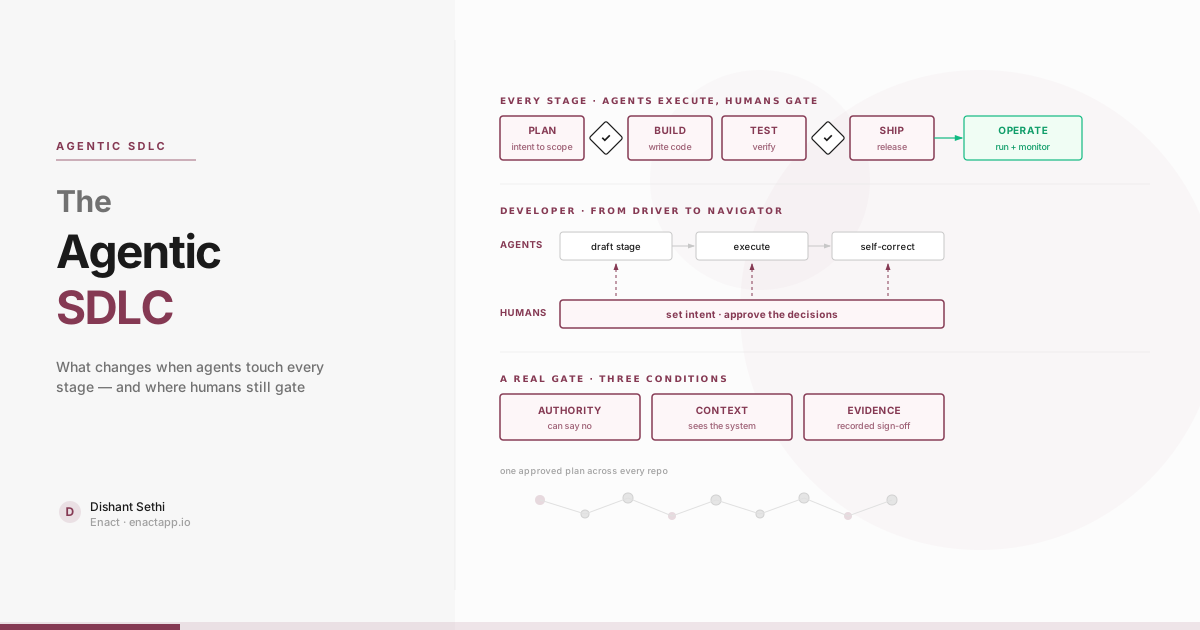
The agentic SDLC (agentic software development lifecycle) is the software delivery model where AI agents do the work of every stage — planning, coding, testing, review, deployment, and operations — while humans set the intent and approve the decisions. It does not add AI to the old lifecycle. It inverts who executes each stage and keeps people on the decisions that used to be implicit in the typing.
Key Takeaways
- The agentic SDLC moves humans from doing each stage to directing it: agents plan, build, test, and ship, while people set intent and approve at the points that matter.
- It is not the traditional SDLC with an AI plugin. Every stage gets faster and more autonomous, which changes where risk concentrates — upstream, at the decisions, not downstream at the diff.
- The load-bearing addition is the human approval gate. Remove the gates and the agentic SDLC is just vibe coding at team scale.
- The hardest stage is no longer writing code — it is reviewing agent output fast enough and well enough to approve it, which takes more system context than any one reviewer usually holds.
- Adopting it is a governance decision before a tooling one: who approves what, on what evidence, and how that sign-off stays traceable into Jira, Linear, and every agent.
What is the agentic SDLC?
The agentic SDLC is a way of running software delivery in which AI agents act as the primary executor at each stage of the lifecycle — requirements, design, implementation, testing, review, release, and operations — and humans move to setting direction and approving outcomes. The agents reason, call tools, write and run code, and self-correct from feedback; people decide what to build and whether to ship it.
The shift is about role, not just speed. In the traditional lifecycle a developer drives every stage and tools assist. In the agentic lifecycle the developer navigates: deciding where to go and correcting course, while agents handle the driving. Industry writeups from Port and others describe the same inversion, and it maps closely onto AWS's AI-driven development lifecycle, which formalizes the same idea into named phases with gates between them.
What makes it genuinely new is that agents are non-deterministic. A build script does the same thing every run; an agent given the same ticket twice can produce two different designs, each plausible, neither obviously wrong. That is why the agentic SDLC cannot be governed the way a CI pipeline is governed — with a green check. It has to be governed the way a team decision is governed — with someone accountable saying yes.
Agentic SDLC vs. the traditional SDLC
The difference between the agentic SDLC and the traditional SDLC is who executes and who decides. The stages are recognizable — you still gather requirements, design, build, test, release, and operate. What changes is that an agent now produces the first full draft of each stage's output, and the human role collapses from authoring the work to validating it. The lifecycle keeps its shape and swaps its labor.
That inversion has a second-order effect teams underestimate. When a human writes the code, the review happens continuously and implicitly — the author makes a hundred small decisions and remembers why. When an agent writes it, those decisions are made in seconds and recorded nowhere unless the process forces them to be. The traditional SDLC spread judgment across the whole stage; the agentic SDLC concentrates it into a few approval moments. Miss those moments and the judgment simply does not happen.
What changes at each stage
Every stage of the lifecycle changes in the agentic SDLC, but not uniformly. The stages where agents are strongest — drafting plans, writing boilerplate, generating tests — compress from days to minutes. The stages that require judgment about the whole system — approving scope, accepting an architecture, deciding something is safe to ship — do not compress at all, and become the real constraint.
Planning. The agent turns a goal or ticket into a concrete plan — scope, approach, affected components, acceptance criteria. This is the stage that gained the most and matters the most, because every later stage inherits it. A wrong assumption here is cheap to fix and catastrophic to miss.
Building. The agent writes the implementation against the approved plan. Output volume stops being the bottleneck almost immediately; a single engineer can now have more code produced in an afternoon than they could review in a week. The scarce resource flips from writing to reading.
Testing. Agents generate unit and integration tests readily, which is both useful and a trap: tests written by the same agent that wrote the code tend to encode the code's assumptions rather than the requirement's. Tests still need a human to confirm they check what was actually promised.
Review. This is where the agentic SDLC either holds or fails. Reviewing a diff line by line does not scale to agent output volume, and it reviews the wrong thing anyway — the expensive mistakes are in the plan, not the syntax. Review has to move upstream to the decision.
Release and operations. Agents can prepare deployments, write infrastructure, and monitor live services. Because the earlier context — what was asked, what was approved — can travel with the work, operational decisions can reference the reasoning that produced the system instead of guessing at it. That is the upside of keeping the lifecycle connected rather than letting each stage start cold.
The new bottleneck: review moves from code to decisions
In the agentic SDLC the bottleneck is no longer how fast your team can write code — it is how fast and how well they can approve what the agent proposes. Agents produce more output than any team can read line by line, so the valuable human review shifts from the diff to the decision: is this the right scope, the right architecture, the right thing to ship? Catching a wrong call at the plan takes minutes; catching it after the build takes a rebuild.
This reframes what a senior engineer is for. Their value in the agentic SDLC is not throughput of code — the agent out-types them easily — but the quality and speed of their judgment at the gates. An agent will build clean, well-tested code from a wrong decision without a flicker of doubt, because it has no way to know the decision was wrong. The only defense is a reviewer who can see what the agent cannot, at the moment it still matters.
And that reviewer needs context the agent does not surface on its own: what already exists in the codebase, which other services the change touches, what was decided last quarter and why. The review is only as good as the context the reviewer brings to it. Volume of output has outrun the context any single person can hold in their head, which is the structural reason the agentic SDLC needs tooling, not just discipline.
Where the agentic SDLC breaks on a team
The agentic SDLC breaks at the gate — not because teams forget to review, but because the person reviewing often cannot see the whole system. Approval becomes genuine but under-informed: a product owner signs off on scope without knowing a service already handles the case; an engineer approves an architecture for the three repos they know and waves through the thirty they do not. The gate did its job procedurally and still let the wrong thing through.
This is the same failure that breaks spec-driven development at team scale. On a solo project the agentic SDLC works beautifully, because the one person directing the agent holds the whole system in their head and every gate is informed. Add a team, multiple repos, and agents working in parallel, and the assumption behind every gate — a reviewer who can meaningfully approve — quietly stops being true. The methodology is sound; the context is missing.
A gate is only real when three things hold at once: someone with the authority to say no is actually reviewing, they have enough context to say no for the right reason, and the decision is recorded as evidence rather than lost in a thread. Miss any one and the gate is theater — the agent moves forward regardless, and you have inherited fast vibe coding with a governance label on it. The faster the agents execute, the more load each gate carries, and the less slack there is to catch a weak decision before it ships.
How to adopt the agentic SDLC without losing control
Adopting the agentic SDLC is a governance decision before it is a tooling one. The throughput gains are real, but they are not the choice you have to make. The choice is whether your team can approve agent output faster than the agents produce it — and whether those approvals hold up when someone asks about them during an incident, an audit, or an onboarding months later.
Three moves make the difference in practice:
- Put the gate at the plan, not the pull request. Approve scope and approach before the agent builds, where a wrong decision is an edit instead of a rebuild. Reserve diff review for what it is good at — correctness in the small — and stop relying on it to catch architectural mistakes it was never going to see.
- Give the gate real context. A reviewer approving a plan should be able to see what already exists in the codebase and every repo the change touches, so the approval is informed rather than hopeful. This is where a planning layer grounded in your codebase earns its place — it carries the context the agent has into the decision the human has to make.
- Keep the sign-off traceable. Record what was approved, by whom, and against what, and keep it attached as the work flows into Jira, Linear, and each coding agent. That record is what preserves accountability when agents wrote most of the code — and what a SOC 2 auditor or a regulator will ask to see. Enact's enterprise AI SDLC playbook walks through the evidence a governed lifecycle should keep.
None of this argues against agents, or against moving fast. It argues that the faster execution gets, the more the decision points carry — and the more deliberately they have to be built. The agentic SDLC is a genuine restructuring of how software gets made, not a rebrand of AI-assisted coding. Get the gates right, with real authority, real context, and a real record, and the speed is safe to keep. Skip them and you have only made the old chaos faster. For the broader framing, CodeRabbit maintains a guide to the agentic SDLC, and AWS's open-source AI-DLC workflows show one way to encode the gates into an agent's steering rules.
Run an agentic SDLC your team can stand behind
The Enterprise AI SDLC Playbook lays out the human gates, codebase context, and traceable sign-off an agentic lifecycle needs to hold up at team scale.
Download the playbook →