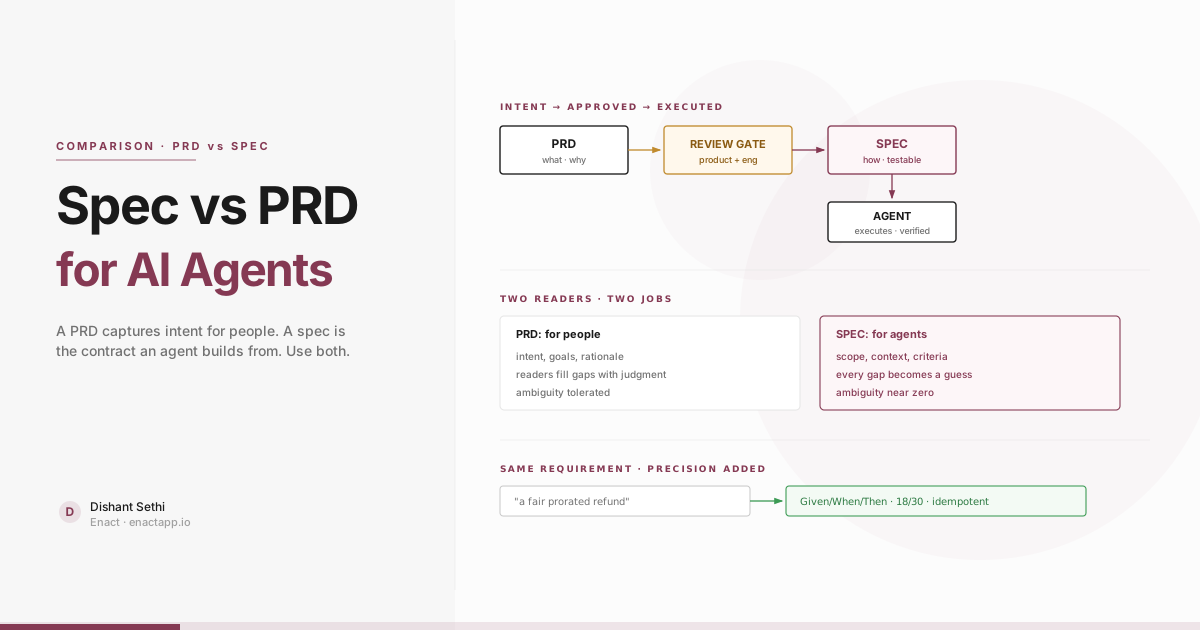
The spec vs PRD question for AI coding work comes down to audience and precision. A product requirements document (PRD) tells people what to build and why; an agent-ready spec is the execution contract an AI coding agent builds from, carrying bounded scope, system context, and testable acceptance criteria. A PRD tolerates ambiguity because human readers fill gaps with judgment. An agent fills the same gaps with a guess.
That single difference is why the popular framing (PRD is dead, the spec replaces it) misreads the problem. The two documents answer different questions for different readers. Teams shipping real systems with coding agents do not pick one. They write both, in sequence, and put a review gate between them.
Key Takeaways
- Different readers, different jobs: A PRD communicates product intent and rationale to people. A spec is a precise, machine-checkable contract an AI coding agent executes against. One explains why; the other defines exactly what.
- Ambiguity is the dividing line: A human engineer resolves a vague PRD line with organizational context. An AI coding agent has no such context, so every unstated constraint becomes a silent assumption that surfaces in code review or production.
- You need both, in order: The PRD aligns stakeholders on the problem. The spec translates the approved intent into scope, system context, and Given/When/Then acceptance criteria an agent can act on and a reviewer can verify before merge.
- The handoff is where teams fail: Drift and rework rarely come from a bad PRD or a bad spec alone. They come from an unreviewed, undocumented jump between them, with no record of who approved what.
- Keep them connected, not stacked: A spec that falls out of sync with the PRD it came from is as dangerous as no spec. The approved intent and the execution contract have to stay linked as requirements change.
Spec vs PRD for AI coding: the core difference
A PRD and a spec are not competing formats. They are two layers of the same decision, separated by who reads them and what that reader is allowed to assume.
| Dimension | Product Requirements Document (PRD) | Agent-Ready Spec |
|---|---|---|
| Primary audience | Product, design, and engineering stakeholders | AI coding agents and the engineers who review their output |
| Core question | What are we building, for whom, and why | Exactly how the system must behave, in testable terms |
| Typical contents | Problem statement, goals, user stories, success metrics, rationale | Bounded scope, out-of-scope list, system context, Given/When/Then acceptance criteria, flagged unknowns |
| Ambiguity tolerance | High: readers resolve gaps with domain judgment | Near zero: every gap becomes an agent guess |
| Lifecycle | Often abandoned once the build starts | Version-controlled and updated alongside the code |
| Verification | Success metrics measured after launch | Acceptance criteria checkable before the merge |
| Failure mode when misused | Too vague for an agent to execute safely | Too much narrative, not enough testable behavior |
| Ownership | Product manager drafts and owns it | Product and engineering approve it jointly |
The matrix makes the relationship clear. The PRD is where a team decides the problem is worth solving and agrees on what success looks like. The spec is where that agreement becomes something an agent can execute and a reviewer can check. Collapsing them into one document either starves the agent of precision or buries the product rationale under implementation detail.
What a PRD is for, and where it stops
A product requirements document captures intent. It states the problem, the users affected, the goals, the success metrics, and the reasoning behind scope decisions. Its job is alignment: getting product, design, engineering, and leadership to agree on what matters before anyone writes code. That is a human coordination problem, and the PRD is good at it.
PRDs are written for readers who share context. When a PRD says "support partial refunds," a human engineer knows which service owns the payment ledger, knows that financial operations need idempotency keys, and knows which tables require audit logging. The PRD can stay at the level of intent precisely because the reader supplies the rest.
This is also where the PRD stops being enough. The moment the reader is an AI coding agent rather than a tenured engineer, the shared context disappears. Hand a model a line like "support partial refunds" and it will produce a statistically plausible implementation from patterns in public code: a direct database write, no idempotency, no audit event, a schema that looks right and violates three unstated invariants. The PRD did not fail as a PRD. It was asked to do a job it was never built for.
That gap is why the "PRD for AI coding agents" searches are rising: teams are discovering that the document that aligned their stakeholders cannot, on its own, drive an agent safely.
What an agent-ready spec adds
A spec is the execution contract. Where the PRD answers what and why, the spec answers exactly how the system must behave in terms both an agent and a test suite can act on. The gap between the two is the context a human would have supplied automatically, now written down. An effective spec for AI coding agents carries five things the PRD usually leaves implicit:
- Bounded scope: what is in, and an explicit out-of-scope list. Without the second half, agents refactor adjacent code, bump dependencies, and add features nobody approved.
- System context: the existing models, services, and shared helpers to reuse. Agents default to generating new code unless told what already exists.
- Testable acceptance criteria: behavior in Given/When/Then form (the Given/When/Then structure from Cucumber's Gherkin syntax, a plain-language way to write test scenarios) so the requirement can be verified mechanically.
- Non-functional constraints: latency budgets, query limits, logging format, the things that are invisible until they break.
- Flagged unknowns: an explicit marker, such as
[NEEDS CLARIFICATION], that forces a human decision instead of an agent guess.
This is the layer open-source tooling has standardized around. GitHub Spec Kit formalizes the cycle into /specify, /plan, /tasks, and /implement commands and supports more than 30 agents, including Claude Code and Cursor. The spec, not the chat prompt, becomes the durable artifact the agent executes against. For a full field-tested structure you can copy, see our AI-ready spec template.
PRD vs specification: how the handoff actually works
The PRD vs specification distinction matters most at the seam between them. Picture the sequence as a pipeline with one mandatory gate.
Workflow summary: A PRD defines the problem and intent, a joint product and engineering review gate approves it, the approved intent becomes an agent-ready spec, the agent executes within bounded scope, and acceptance criteria are verified before merge so every change traces back to approved intent.
The documents are not interchangeable and they are not optional. Skip the PRD and the spec encodes one person's unreviewed assumptions about what the team wants. Skip the spec and the agent improvises the contract. Skip the review gate between them, which is the most common failure, and you get precise code that faithfully implements the wrong intent. The rework that follows is not an agent problem. It is a missing-handoff problem, and teams routinely underestimate its cost; you can put a number on it with our rework ROI calculator.
How to write specs for AI coding agents from a PRD
You do not throw the PRD away. You translate its approved intent into an execution contract. The template below is the conversion layer: copy it, and fill each field from the PRD plus the system knowledge the PRD assumed. This is how to write specs for AI coding agents without losing the product reasoning the PRD captured.
# Spec: [Feature Name]
> Source PRD: [link] · Approved: [names / date]

## 1. Intent (from the PRD)
<!-- One or two sentences. Carry the PRD's "why" so the spec stays traceable. -->
Enable [user] to [outcome] so that [business goal]. See PRD for full rationale.

## 2. Scope
### In-Scope
- [Behavior 1]
- [Behavior 2]
### Out-of-Scope
<!-- The half the PRD never states. Agents treat silence as permission. -->
- Do not modify authentication or middleware.
- Do not add external dependencies without approval.
- Do not touch services outside [target service].

## 3. System Context (the context a human would assume)
- Target services / repos: [e.g. payments-service, billing-service]
- Models to reuse: [e.g. UserAccount in lib/models/account.ts]
- Shared helpers: [e.g. verifySession() in auth/session.ts; no custom auth]
- Non-functional: [p95 < 120ms; structured JSON logs with correlation ID]

## 4. Acceptance Criteria (Given / When / Then)
- Scenario: Successful partial refund
  - Given an authorized charge in 'settled' state
  - When a partial refund is requested via POST /v1/refunds
  - Then record the refund idempotently and emit a 'billing.audit.refund' event
- Scenario: Duplicate request
  - Given two requests with an identical idempotency key
  - When both reach the service concurrently
  - Then execute exactly once and return identical responses

## 5. Flagged Unknowns
<!-- Force a human decision instead of an agent guess. -->
- [NEEDS CLARIFICATION: retry policy - exponential backoff or fixed interval?]

## 6. Approval Sign-Off
- Product: [name / date]   Engineering: [name / date]
The PRD supplies sections 1 and part of 4. The engineering context (sections 2, 3, and the non-functional lines) is exactly what the PRD let its human readers assume. Writing it down is the whole point: it is the difference between an agent that executes and one that invents.
Who writes and approves which
Most published PRD vs specification content stops at the document comparison. The harder question for a team using coding agents is ownership, because the two documents have genuinely different authors and a shared approval.
- The PRD is the product manager's artifact. They own the problem, the users, the goals, and the success metrics. For how a PM should pressure-test intent before it reaches an agent, see our guide to a PM reviewing an AI coding agent's plan.
- The spec is a joint artifact. The PM confirms the behavior still matches the intent; engineering supplies the system context and non-functional constraints the PM cannot see. Neither party can approve it alone, because neither holds the full picture. This is the collaborative review that spec approval workflows for AI coding agents are built to enforce.
- The connection between them is nobody's job by default, which is why it breaks. When specs are static markdown copied into repos, they drift from the PRD and from the codebase the moment either changes. Keeping product requirements for AI agents synchronized across services is a standing problem we cover in preventing spec drift.
This is the part a pair of documents cannot solve on their own. A PRD in a doc tool and a spec in a repo have no link between them, no shared approval record, and no awareness of the codebase either describes. Platforms like Enact close that gap: product intent, team decisions, and real codebase context become one plan that product and engineering approve together, and that approval stays traceable as the work moves into Jira, Linear, and the coding agent itself. The documents stop being two disconnected files and become one governed layer.
Before and after: the same requirement, two readers
The clearest way to see the spec vs PRD difference is to watch one line travel from PRD intent to agent-ready spec.
PRD line (for people):
Users should be able to cancel a subscription and get a fair prorated refund.
A human reads "fair" and knows to check the billing policy, the proration rounding rule, and the dunning state machine. An agent reads "fair" and invents one.
Spec translation (for the agent):
- Scenario: Mid-cycle cancellation with proration
  - Given an active monthly subscription 12 days into a 30-day cycle
  - When the user cancels via POST /v1/subscriptions/{id}/cancel
  - Then refund the unused portion rounded down to the cent (18/30 of the fee)
  - And set subscription state to 'canceled_at_period_end'
  - And emit 'billing.subscription.canceled' with the refund amount
- Out-of-scope: do not alter dunning retry logic or tax calculation.
Same requirement. The PRD kept the intent legible to stakeholders; the spec removed every place the agent could guess. You need the first to agree on the goal and the second to ship it safely.
Keep the PRD and the spec on one approved plan
Copy the template above, then see how Enact turns product intent into an agent-ready spec, grounded in your real codebase and approved by product and engineering together.
See the plan workflow →