Most teams adopting coding agents describe the same failure the same way: the agent shipped something fast, and nobody decided it should exist. The code was clean. The tests passed. The architecture was wrong, and no one signed off on it. AIDLC is the response to exactly that gap — a way of working that keeps the speed and puts the decisions back under human control.
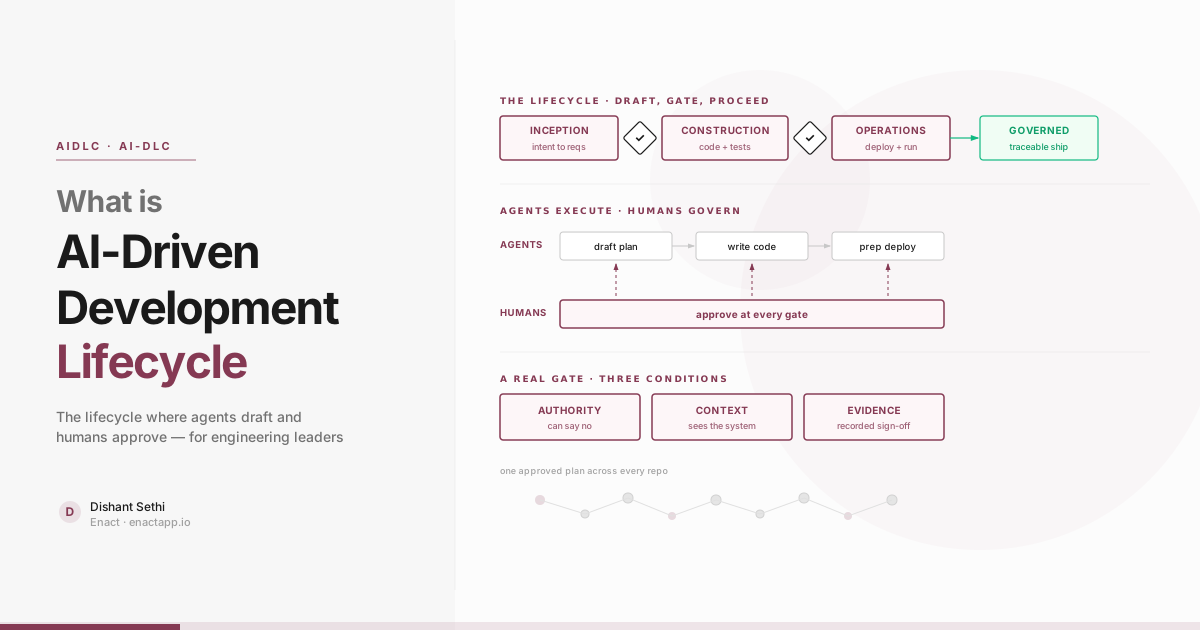
AIDLC — the AI-driven development lifecycle — is a methodology for building software where AI agents do the drafting and humans make the decisions. Agents turn intent into requirements, code, and tests across defined phases; people validate and approve at a gate before each phase proceeds. It moves teams from "humans build, AI assists" to "agents build, humans govern."
Key Takeaways
- AIDLC reorders the software lifecycle around AI agents that draft and human teams that approve — the opposite of ad-hoc, prompt-by-prompt "AI-assisted coding."
- AWS introduced the methodology in three phases: Inception (intent → requirements), Construction (architecture → code → tests), and Operations (deploy → run), each moving in short cycles.
- The load-bearing part is not the automation — it is the human approval gate between phases. Remove the gates and AIDLC is just fast vibe coding.
- For engineering leaders, AIDLC is a governance question before it is a tooling one: who approves what, on what evidence, and how that decision stays traceable as the work moves into Jira, Linear, and every coding agent.
- It breaks the same way spec-driven development breaks on a team — the person approving often can't see the whole system. Closing that gap is where a planning layer earns its place.
What is AIDLC?
AIDLC (AI-driven development lifecycle, also written AI-DLC) is a way of running software delivery in which AI agents generate the artifacts of each stage — requirements, architecture, code, tests, and operational work — and humans review and approve those artifacts before the next stage begins. The point is not to remove people. It is to move them from typing the work to deciding the work.
The clearest published definition comes from AWS, which originated the term. The open-source awslabs/aidlc-workflows project describes AI-DLC as a method that "turns AI coding assistants into structured, verifiable software-delivery workflows," and states the problem it exists to solve plainly: "Ad-hoc AI coding loses context as projects grow. AI-DLC keeps requirements, decisions, implementation, tests, and operational work connected through one audited lifecycle."
That framing is the whole idea. A coding agent given a one-line prompt will produce working code and no record of why. AIDLC keeps the reasoning attached to the output — what was asked, what was decided, what was approved — so the lifecycle stays auditable instead of dissolving into a chat history nobody can reconstruct.
AIDLC vs. AI-assisted coding
The difference between AIDLC and AI-assisted coding is sequence and authority, not tooling. Both use the same agents — Cursor, Claude Code, Amazon Q, Copilot. AI-assisted coding steers an agent conversationally, decision by decision, in the moment. AIDLC front-loads the decisions into approved artifacts, then lets the agent execute against them. One optimizes for the next keystroke; the other optimizes for a delivery you can stand behind.
The distinction matters because the two modes fail differently. AI-assisted coding fails quietly: a single developer nudges an agent toward an answer that looks right and merges it, and the shortcut only surfaces weeks later. AIDLC is designed to fail loudly and early — at a gate, in front of the people who can catch it — which is exactly when a wrong decision is cheapest to reverse. This is the same reason spec-driven development front-loads disagreement: you argue about scope while it is still an edit, not an incident.
The phases of AIDLC
AWS defines AIDLC in three phases, each run in short cycles rather than long stage-gates. The sequence is deliberate: every phase enriches the context the next one inherits, so the agent's outputs get more informed as the work proceeds instead of restarting from a cold prompt each time. Humans validate the output of each phase before the next begins.
Inception — intent becomes requirements. The agent takes a business goal and drafts requirements, user stories, and units of work, surfacing the questions it cannot answer alone. The team resolves those questions together in a working session AWS calls "mob elaboration," then approves the result. Ambiguity is closed here, on purpose, because it is the cheapest place to close it.
Construction — requirements become working software. Using the approved context, the agent proposes an architecture and a domain model, then writes and tests the code. People review the technical decisions collaboratively — "mob construction" — rather than rubber-stamping a pull request after the fact. The approved plan, not a fresh prompt, is what the agent builds against.
Operations — software becomes a running system. The agent uses the requirements from Inception and the technical decisions from Construction to prepare deployment, automate infrastructure, and monitor the live service. Because the earlier context is still attached, operational work references the decisions that produced the system rather than guessing at them.
Different implementations slice this differently. The AWS toolkit expands the same lifecycle into a finer-grained workflow — the awslabs project describes "5 phases and 33 stages from initialization through operation" — but the shape is constant: draft, gate, proceed.
Where humans gate: the part leaders own
Strip the automation away and the defining feature of AIDLC is the human approval gate. The awslabs project lists "human approval gates and source-bound review evidence" as core capabilities, and describes a workflow that "asks for missing decisions" and stops "at approval gates before moving forward." The gates are not a safety wrapper bolted onto agent output — they are the methodology.
This is where AIDLC becomes an engineering-leadership concern rather than a developer-tooling one. A gate is only real if three things are true: someone with the authority to say no is actually reviewing, they have enough context to say no for the right reason, and the decision is recorded as evidence rather than lost in a thread. Miss any one and the gate is theater. The agent moves forward anyway, and you have inherited fast vibe coding with a governance label on it.
"Source-bound review evidence" is the detail worth dwelling on. It means an approval is tied to the specific artifact and reasoning it approved, so that months later — during an incident, an audit, or an onboarding — you can answer who approved this, against what, and why. That is the difference between an agent-built codebase you can defend and one you can only apologize for.
What AIDLC changes for engineering leaders
For an engineering leader, AIDLC is a governance model before it is a productivity story. The throughput gains are real, but they are not the decision you have to make. The decision is whether your team can approve agent output faster than the agent produces it — and whether those approvals hold up when someone asks about them later.
That reframes three familiar responsibilities:
- Review shifts from code to decisions. The valuable human review in AIDLC happens at the plan, not the diff. Catching a duplicated service or a wrong data model at the Inception gate takes minutes; catching it after Construction takes a rebuild. Your review capacity should move upstream to match.
- Traceability becomes a deliverable. When agents write most of the code, "who decided this" stops being obvious from the commit history. The approval record is what preserves accountability — and it is what a SOC 2 auditor or a regulator will ask to see. Enact's enterprise AI SDLC playbook walks through the evidence a governed lifecycle should keep.
- Speed exposes weak decisions faster. Agents compress the gap between a bad call and its consequences. AIDLC's answer is not to slow the agent down but to make the decision points explicit, so the organization catches weak decisions at a gate instead of in production.
None of this argues against agents, or against moving fast. It argues that the faster the execution, the more load the decision points carry — and the more deliberately they have to be built.
Where AIDLC breaks on a team
AIDLC assumes a reviewer who can meaningfully approve what the agent proposes. On a real team, that assumption is exactly where it strains. The methodology is sound; the failure mode is human. The person at the gate frequently cannot see the whole system, so the approval is genuine but under-informed — and the agent builds the gap into shipped code anyway.
The mechanism is the same one that breaks spec-driven development at team scale. A product owner approves requirements without knowing that the notification service already handles the case. A developer approves an architecture for the three services they know and waves through the thirty they don't. The gate did its job procedurally and still let the wrong thing through, because approving well requires context no single reviewer holds. An agent will build clean code from a wrong decision without a flicker of doubt.
Closing that gap is a tooling problem AIDLC names but does not solve on its own. It needs the gate to carry live codebase context, so a reviewer approving a plan can see what already exists; it needs one approved plan that spans every repo a feature touches, not per-repo drift; and it needs the sign-off to stay attached as the work flows into Jira, Linear, and each coding agent. That connective layer — grounding the plan in the code and keeping one approved source of truth across repos — is what Enact is built to provide, and it is what turns AIDLC's gates from a diagram into something a team can actually run.
AIDLC is a genuine shift, not a rebrand. Naming the phases and, above all, the gates gives teams a shared model for the one question agents make urgent: not can the machine build it, but who decided it should be built, and can they prove it. Get the gates right and the speed is safe to keep. Skip them and AIDLC is just the old chaos, moving faster.
Put real approval gates around your coding agents
The Enterprise AI SDLC Playbook lays out the human gates, traceable sign-off, and codebase context an AIDLC workflow needs to hold up.
Download the playbook →