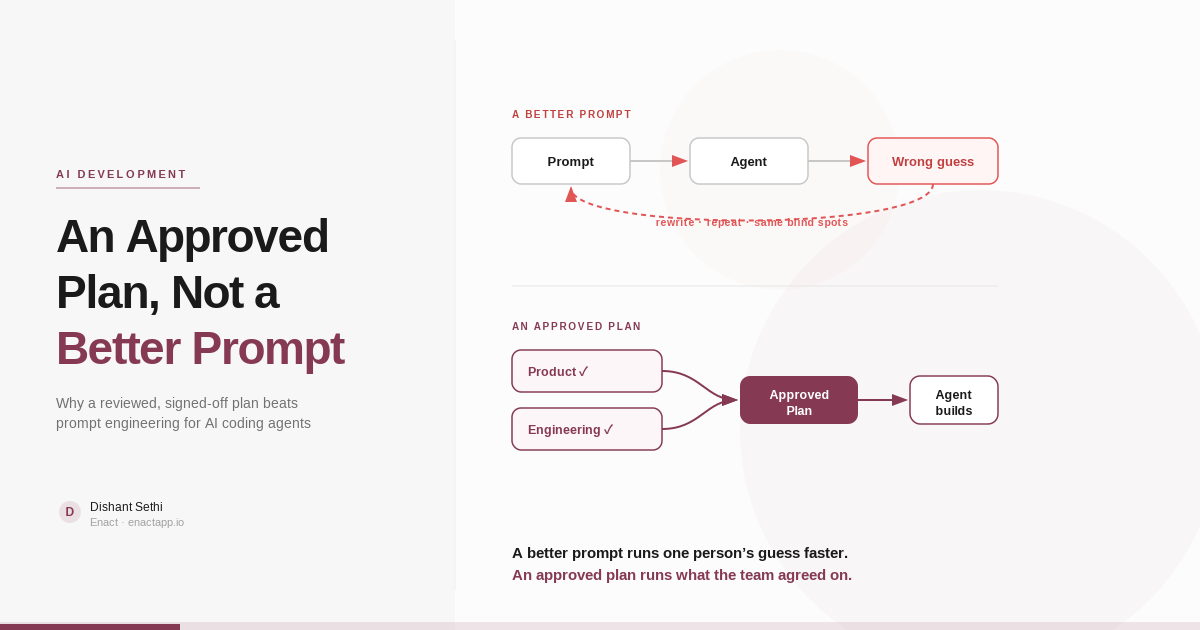
When an AI coding agent ships the wrong thing, the first instinct is to write a better prompt. An approved plan fixes more than any prompt rewrite ever will, because the failure is rarely bad wording. It is a decision nobody made, or one person made alone, before the agent started typing.
An approved plan for an AI coding agent is a reviewed, signed-off specification that product and engineering agree on before any code is generated. Unlike a prompt, which carries one author's intent at a single moment, an approved plan captures the constraints, scope boundaries, and cross-team decisions the agent would otherwise fill in with a statistical default.
Key Takeaways
- Prompt quality has a ceiling: A perfect prompt still encodes only what its one author knows. It cannot capture a decision that needs a second person's sign-off.
- Prompt engineering vs planning is the wrong fight: Better wording speeds up execution of the same unreviewed intent. Planning changes whose intent gets executed.
- A prompt is ephemeral, a plan is a record: Prompts live and die in a chat thread. An approved plan persists, versions, and travels into Jira, Linear, and the agent.
- "Approved" is the load-bearing word: The value is not a cleaner instruction. It is the review gate where product and engineering resolve ambiguity before code exists.
- Even the best planning tools stop at a prompt: Competitors that correctly diagnose "the missing plan" often hand the result back as a refined prompt rather than an enforced, auditable agreement.
Why a better prompt hits a ceiling
Prompt engineering treats an agent failure as a communication problem: the model misunderstood, so say it more clearly next time. That framing works right up to the point where the missing information was never in the author's head to begin with.
Consider an illustrative scenario common across engineering teams. A product manager prompts a coding agent: "Let users delete their account and all associated data." The wording is clear. It is also wrong, because the company retains financial ledger records for seven years under regulatory rules the PM has never read. No amount of prompt refinement closes that gap, because the constraint does not live with the person writing the prompt. It lives with engineering, or compliance, or a staff engineer who happens to remember the retention policy.
This is the structural limit of prompt engineering vs planning. A prompt is bounded by one author's knowledge at one moment. A plan is the artifact a team uses to pool knowledge that no single author holds. You cannot prompt your way to a decision that requires someone else's approval.
Workflow summary: Rewriting prompts keeps the same author iterating against the same blind spots, while an approved plan brings a second reviewer in to resolve the missing decision before the agent builds.
What a prompt carries, and what an approved plan carries
A refined prompt and an approved plan look similar on screen: both are text that tells an agent what to build. The difference is not length or clarity. It is authorship, review, and durability.
| Dimension | A better prompt | An approved plan |
|---|---|---|
| Authorship | One person's intent | Agreement across product and engineering |
| Missing decisions | Filled by the agent's default | Surfaced and resolved before coding |
| Review | None, or a glance in chat | Explicit section-by-section sign-off |
| Lifespan | Ephemeral, lost in the thread | Persistent, versioned artifact |
| Scope boundaries | Implied | Stated non-goals and out-of-scope lines |
| Auditability | A screenshot, at best | A record of who approved what, and when |
The row that matters most is "missing decisions." A prompt, however well engineered, hands unresolved ambiguity to a model that resolves it by picking the most common pattern in its training data. That is a reasonable default for a blog scaffold and a dangerous one for a billing path. An approved plan forces the ambiguity to the surface while a human can still catch it. For teams adopting structured specs for the first time, the mechanics are covered in our guide to spec-driven development for teams.
The AI agent planning layer sits above the prompt
The useful mental model is a layer, not a message. An AI agent planning layer is the place where intent becomes an agreement before it becomes a prompt. The prompt is an output of that layer, not a replacement for it. This is what AI coding agent planning means in practice: not a cleverer instruction, but a shared artifact a team reviews before anyone runs the agent.
This reframes the whole "prompt engineering vs planning" debate. Planning does not make prompts obsolete. It makes them downstream. A planning layer takes product intent, pulls in the relevant codebase context, lets engineering flag feasibility and blast radius, captures the sign-off, and only then produces the instruction the agent executes. The prompt still exists. It is just no longer the first or the only artifact.
Anthropic's own tooling gestures at this with Claude Code's plan mode, a read-only step where the agent proposes changes and waits for approval before editing. That is a good primitive at the individual-developer level. It still assumes the approver is the single person at the keyboard, which is exactly the gap planning closes for a team: the person who needs to approve the retention decision is usually not the person running the agent.
Where "the missing plan" argument stops short
Enact is not the only tool that has noticed this. CodeRabbit built a product around the same diagnosis, and it is worth engaging honestly, because the diagnosis is correct. Its Plan product page states the thesis plainly: "The problem isn't your agent. It's the missing plan." We agree with that sentence completely.
The distinction is what happens after the plan exists. By its own description, CodeRabbit's Plan takes an issue or a prompt, researches the codebase, and produces a refined prompt you can copy and send to Cursor, Windsurf, or GitHub Copilot. That is a real improvement over a one-line ticket. But a refined prompt is still an instruction, not an agreement. The leap from "better prompt" to "approved plan" is the review gate and the durable sign-off, and that leap is where a prompt-centric workflow stops short.
An approved plan is only worth the word "approved" if the approval is recorded, role-based, and enforced as the work moves downstream. A plan that becomes a prompt the moment it is generated has quietly collapsed back into the thing it was supposed to replace.
What "approved" actually requires
Approval is not a thumbs-up emoji on a Slack message. For a plan to govern an agent's behavior, three things have to be true.
- Named roles sign specific sections. Product approves functional scope and acceptance criteria. Engineering approves architecture, data access, and cross-service impact. Each sign-off is attributable, following a defined spec approval workflow for AI coding agents.
- The plan is grounded in the real codebase. References to models, services, and APIs are validated against the live code, not assumed. A plan that cites a table that was renamed last quarter approves a fiction.
- Changes re-enter the same gate. When scope shifts mid-build, the revision routes back through review rather than landing as a fresh prompt in the agent's terminal. This is the single most common way an approved plan silently degrades into an unreviewed one.
When those hold, the plan stops being documentation and becomes the contract the agent executes against. The approved plan can then be delivered to coding agents dynamically over the Model Context Protocol (MCP), the open standard for feeding tools and context to AI assistants, so the instruction the agent sees is the one the team signed off on, not a paraphrase someone pasted into a chat window.
What changes for each role
Moving from prompt-tuning to an approved-plan model is an organizational change, not a tooling swap. It lands differently depending on where you sit.
- Product managers stop writing one-shot prompts and start writing reviewable intent: the problem, the user journey, the explicit non-goals. They review requirement tracking rather than code diffs, a workflow detailed in how PMs review an AI coding agent's plan.
- Engineering leads get a checkpoint to flag feasibility and multi-repo blast radius before an agent commits to a local-only implementation. That matters most when a change crosses service boundaries, as explored in AI coding agents across multiple repos.
- Platform and compliance teams get an audit trail: a record of who approved which decision, which is the artifact regulators ask for and a chat history cannot provide.
None of this argues against moving fast, and none of it argues against coding agents. A good agent executing an approved plan is faster than a good agent executing a vague prompt, because it is not generating work that review will later throw away. You can estimate the cost of that thrown-away work with our rework ROI calculator. The planning layer is what lets teams keep agent speed without inheriting agent guesses. Platforms like Enact exist to hold that layer: turning product intent and codebase context into a plan product and engineering approve together, then keeping that approval traceable as the work reaches Jira, Linear, and any coding agent.
See an approved plan reach the agent, not just a better prompt
Watch how Enact turns intent into a plan product and engineering sign off together, then enforces it as agents build.
Watch the demo →