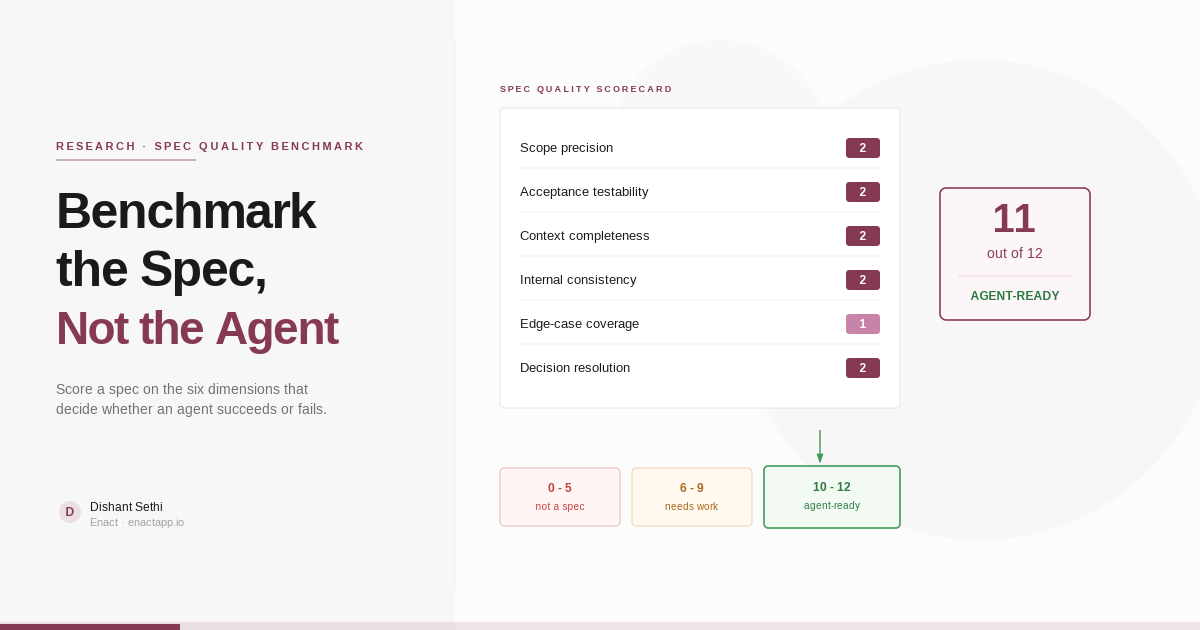
Teams measure the agent and ignore the input. An AI spec quality benchmark turns that around: it scores the specification itself, because a coding agent's output is only ever as good as the plan it was handed. When an agent ships the wrong thing, the post-mortem almost always blames the model. The more useful question is whether the spec was ever good enough to succeed with in the first place.
That question has no published answer yet. There are mature benchmarks for agents and none for the specs they consume, even though the spec is the variable a team actually controls. This post proposes a reproducible way to close that gap: a scoring rubric for spec quality, grounded in decades of requirements-engineering research, extended for what coding agents specifically need, and open for any team to run on its own backlog.
An AI spec quality benchmark scores a specification on the dimensions that decide whether a coding agent can execute it: scope precision, acceptance testability, context completeness, internal consistency, edge-case coverage, and resolved decisions. A spec that scores low does not fail at build time. It fails before the agent starts, because every gap it leaves open becomes a guess.
Key Takeaways
- Benchmark the input, not just the agent: Agent leaderboards like SWE-bench deliberately removed underspecified tasks. The spec decides whether a task is solvable at all.
- Spec quality is measurable: Six dimensions, drawn from the ISO/IEC/IEEE 29148 requirements standard and extended for agents, give a 0 to 12 score you can compute in minutes.
- The failure is upstream: A low-scoring spec does not break during the build. It breaks the moment the agent fills an open gap with its own priors.
- The rubric is the dataset: The scorecard below is the reproducible instrument. Run it on your own tickets and you have a real spec-quality measurement, not a vibe.
- Ambiguity needs a human: Automated checks catch structural smells, but resolving and approving the hard decisions is still a human step, which is the part a planning layer makes traceable.
Why benchmark the spec instead of the agent?
The industry already benchmarks agents thoroughly. SWE-bench, the standard evaluation for coding agents, measures the share of real GitHub issues an agent resolves, where "resolved" means the project's own test suite passes after the agent's patch is applied. It is a good benchmark. It is also a benchmark of the agent, holding the task fixed.
Here is the detail most teams miss. The widely cited SWE-bench Verified subset exists because the original task set contained issues that were underspecified or impossible to grade, and a human screening pass removed them. In other words, the people who build agent benchmarks already know that specification quality determines whether a task is solvable, so they filtered for it before scoring the models. The spec quality was controlled for precisely because it is the dominant variable.
Your backlog has no such screening pass. The tickets you hand an agent are the raw, unfiltered version, and their quality varies wildly. Benchmarking the agent on a clean dataset tells you very little about what will happen when the same agent meets a two-line Jira ticket that says "add partial refunds, update the ledger, add tests." The thing you can actually change is the spec. So that is the thing worth measuring.
This is the same mechanism behind why the same spec handed to multiple AI coding agents produces divergent builds: the agents are not the problem, the open questions are. Divergence across agents and failure within one agent are two readings of a single root cause, and both are proportional to how much the spec leaves unspecified.
What makes a spec good? Six quality dimensions
Software engineering has studied requirement quality for forty years, and the standards are specific about it. ISO/IEC/IEEE 29148:2018, the requirements-engineering standard, defines the characteristics of a well-formed requirement, including necessary, unambiguous, complete, consistent, and verifiable. Research on "requirement smells" operationalizes those characteristics into detectable defects, and Femmer and colleagues report that ambiguity and incompleteness are the smells that show up most often in real documents.
None of that literature was written with coding agents in mind, but it transfers almost directly, because an agent is an unusually literal reader. A human engineer closes a gap in a spec by asking in standup. An agent closes the same gap silently, using its training priors, and you discover the choice in code review. The dimensions that matter for a human matter more for an agent, because the agent never asks.
These are the six spec quality metrics the benchmark scores. Each one maps to a requirement characteristic, a concrete agent failure mode, and something the spec can pin down.
| Dimension | What it measures | Failure mode when it is missing |
|---|---|---|
| Scope precision | What is in scope and, explicitly, what is out of scope (non-goals) | The agent refactors three files to make the change "clean" and breaks an unrelated contract |
| Acceptance testability | Verifiable, example-backed criteria for "done," not adjectives | The agent builds a defensible reading of a vague requirement that is not the one you meant |
| Context completeness | The exact files, services, data model, and contracts the change touches | The agent invents a module, duplicates an existing utility, or writes to the wrong table |
| Internal consistency | No contradictions inside the spec or against existing code | The agent implements one of two conflicting statements, with no signal it chose |
| Edge-case coverage | Named failure modes, not only the happy path | Idempotency, auth, empty states, and error handling are absent, so the agent ships happy-path only |
| Decision resolution | The hard choices are made and recorded, not deferred | Each open decision becomes a guess, and the guesses compound across the change |
The first four are straight from the 29148 characteristics. Edge-case coverage is completeness applied to behavior rather than nouns. Decision resolution is the one dimension the classic standards undersell, because a human spec can leave a decision implicit and a human will resolve it in conversation. An agent cannot, which is why an AI-ready spec template treats resolved, written-down decisions as a first-class section rather than an afterthought.
The spec quality benchmark: a scoring rubric
Score each dimension 0, 1, or 2. The rubric is deliberately coarse, because a finer scale invites false precision the underlying judgment cannot support.
- 0 - Absent: The dimension is not addressed. The agent will have to guess.
- 1 - Partial: The dimension is gestured at but leaves a defensible gap.
- 2 - Resolved: The dimension is specific enough that a literal reader has nothing left to decide.
Total the six dimensions for a score out of 12, and read it against three bands:
- 10 to 12 - Agent-ready: Hand it over. Remaining risk is model capability, not specification.
- 6 to 9 - Needs work: The agent will produce something, but expect rework on the gaps. Fix the lowest-scoring dimensions first.
- 0 to 5 - Do not hand to an agent: The output will be a confident guess. This is a ticket, not a spec.
Here is the full instrument as a copy-paste scorecard. This is the reproducible part: paste it into a ticket, score the spec, and you have measured it.
## Spec Quality Scorecard

| Dimension            | Score (0-2) | Note / gap to close           |
|----------------------|-------------|-------------------------------|
| Scope precision      |             | In-scope + explicit non-goals |
| Acceptance testability |           | Verifiable, example-backed    |
| Context completeness |             | Exact files / services / data |
| Internal consistency |             | No contradictions             |
| Edge-case coverage   |             | Named failure modes           |
| Decision resolution  |             | Hard choices made + recorded  |
| **Total**            | **   / 12** |                               |

Bands: 10-12 agent-ready · 6-9 needs work · 0-5 not a spec
Workflow summary: A spec scored across the six dimensions lands in one of three bands. A low score predicts a confident wrong build and rework, a mid score predicts partial work with gaps, and a high score predicts a first-pass build where the only remaining risk is the model's own capability.
How spec quality maps to agent success rate
The reason this rubric predicts anything is that agent success rate on specs is governed by how many open decisions the agent has to make, and each dimension above is a count of open decisions. A spec that scores 12 has, by construction, left nothing for the agent to resolve. A spec that scores 4 has left eight half-decisions, and the agent will resolve all eight against its own priors, independently, with no signal to you about which way it went.
This compounds. One unresolved decision is a coin flip you might win. Six unresolved decisions across scope, behavior, and edge cases is a product of six probabilities, and the joint odds that every silent guess matches your intent fall off fast. That is why underspecified tasks were filtered out of SWE-bench Verified rather than scored: not because they were hard, but because success on them is close to unmeasurable. The spec was doing the deciding, not the model.
It is worth stating the honest limit. Spec quality is one axis of agent success, and model capability is the other. A flawless spec cannot rescue a task that is genuinely beyond the agent's reach, and benchmark numbers themselves are contested: contamination-controlled variants of SWE-bench report markedly lower scores than the headline leaderboards, so treat any single figure with caution. What a high spec score buys you is the removal of the one axis you control, so that when an agent fails, you actually learn something about the model instead of re-discovering that your ticket was vague. Choosing tooling that measures this well is part of how to evaluate an AI planning tool, and benchmarking the plan fits into the wider map of where AI helps and hurts across the SDLC.
An illustrative scoring pass
Consider an illustrative example, the kind of ticket any team can score in its own backlog. Start with a typical Jira line:
Add partial refunds. Expose an API. Update the ledger. Add tests.
Scored against the rubric: scope precision 0 (no non-goals, unclear which services), acceptance testability 0 ("fair refund" is undefined), context completeness 0 (no files or ledger module named), internal consistency 1 (nothing contradicts, because nothing is specified), edge-case coverage 0 (no idempotency, auth, or currency rules), decision resolution 0. Total: 1 of 12. Not a spec. An agent will build something, and it will be a guess.
Now the same intent, tightened:
## Partial refunds
In scope: prorated refund against a settled charge, support-initiated.
Non-goals: no refunds on disputed charges, no partial-of-partial.
Contract: idempotent POST /v1/refunds, Idempotency-Key header,
  201 on create, 200 on replay, 409 on exceeding remaining balance.
Formula: refund = charge * (days_remaining / term_days), rounded
  down to whole cents, in the charge currency.
Writes: ledger entries via billing/ledger.ts only.
Edge cases: zero days remaining -> 422; already fully refunded -> 409.
Acceptance: fail-to-pass tests for replay, over-refund, currency rounding.
Rescored: every dimension reaches 2 except edge-case coverage, which sits at 1 because concurrency under simultaneous refund requests is still unstated. Total: 11 of 12. Agent-ready, with one named gap a reviewer can close in a sentence. The intent did not change between the two versions. The number of decisions left to the agent went from eleven to one, and that is the entire difference between a build you review and a build you rewrite.
Running the benchmark on your own backlog
The benchmark is only useful if it runs where the specs live, which is your ticketing system and your pull requests. A practical rollout:
- Score at the gate, before an agent is assigned. Add the scorecard to the ticket template so the score is computed while the spec is being written, not after a failed build. This mirrors the research finding that requirement smells are cheapest to catch the moment the requirement is written down.
- Block agent assignment below the threshold. A ticket under 6 does not go to an agent. It goes back for the lowest-scoring dimension to be filled in. The threshold is the control, not the paperwork.
- Automate what is mechanical, keep humans on ambiguity. Structural checks (are non-goals present, are acceptance criteria example-backed, are files named) can be linted. Ambiguity and consistency still need a reader, because automated smell detection trades precision for recall and will not catch a plausible-but-wrong requirement. Model the cost of the rework this avoids with the rework ROI calculator.
- Track the score over time, not the agent. If your average spec score is climbing, your agent success rate will climb with it, and you will have moved the lever that is actually yours to move.
Doing this by hand, on every ticket, is real work, and it is work that tends to decay under deadline pressure. A planning layer like Enact makes the scoring structural: it turns intent into a spec that names scope, contracts, and edge cases, has product and engineering resolve and approve the open decisions together, and keeps that approved plan attached as the work moves into Jira, Linear, and the coding agent. The benchmark stops being a checklist someone remembers to run and becomes the shape of the plan itself.
The takeaway is not that agents are unreliable. It is that "the agent failed" is usually a measurement error. Benchmark the spec first, and most of what looked like model failure turns out to be a specification that scored a 3 and was never going to succeed. Fix the input you control, and the agent's real capability finally becomes the thing you are measuring.
Score your specs before the agent does
Bring a real ticket. We will score it live against the rubric, show where an agent would guess, and how Enact resolves and records those decisions before any build starts.
Book a call →