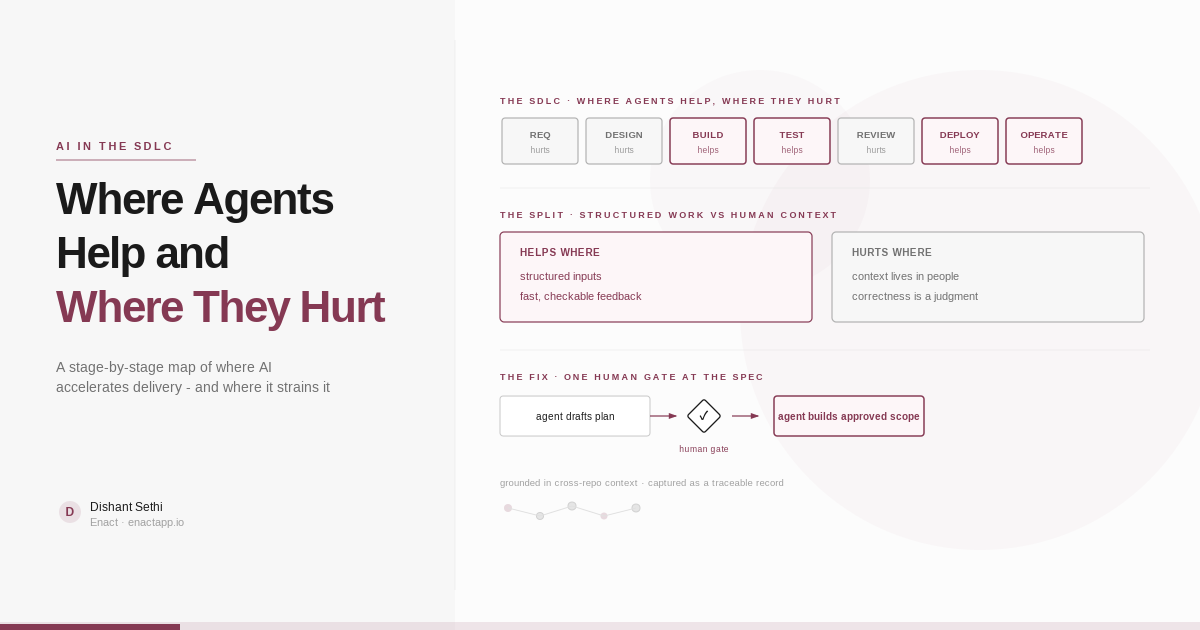
Adopting AI in SDLC work is no longer a decision any engineering team debates; it is the default. The open question is narrower and more uncomfortable: the gains are not spread evenly across the lifecycle. An AI coding agent that turns a ticket into a merged pull request in minutes is genuinely transforming the build stage, while quietly moving risk into the two stages that were already the hardest to get right.
AI in the SDLC (software development lifecycle) helps most where work is structured and verifiable, such as code generation, test scaffolding, and operational triage, and hurts most where work depends on shared human judgment, such as requirements, architecture, and review. The velocity gain is real; it just relocates the bottleneck upstream rather than removing it.
Key Takeaways
- The benefit is uneven, not universal: AI accelerates coding, test generation, and operations, where the inputs are structured. It struggles in planning, requirements, and review, where context lives in people's heads.
- Velocity relocates the bottleneck: Faster code authoring does not shrink the lifecycle; it concentrates risk at the specification and review boundary, where errors are cheapest to catch and most often skipped.
- The data confirms the split: Google Cloud's 2025 DORA research found AI adoption now correlates positively with delivery throughput but still negatively with delivery stability.
- Trust is falling as usage rises: Developers use AI more each year while trusting its output less, which makes unverified agent decisions an organizational liability, not just an individual one.
- Gates belong where AI hurts: The fix is not fewer agents but a human approval gate at the planning stage, grounded in real codebase context and captured as a traceable record.
What does "AI in the SDLC" actually mean?
AI in the SDLC refers to the use of generative models and autonomous agents to perform or assist the operational work of each software lifecycle phase, from requirements and design through coding, testing, deployment, and operations. It spans passive assistance (code completion, documentation drafts) and active execution (agents that plan, write, test, and open pull requests with limited human input).
The term covers a wide spectrum, and conflating the ends of it is where teams get into trouble. Autocomplete suggesting the next line is a different risk profile from an agent that reads a Jira ticket, resolves architectural trade-offs on its own, and ships a branch. Both are "AI in the software development lifecycle," but only one of them makes decisions nobody signed off on.
Google Cloud's 2025 DORA report on AI-assisted software development found AI adoption among developers has reached roughly 90 percent, and for the first time measured a positive relationship between AI adoption and software delivery throughput. The same research found the relationship with delivery stability remained negative. AI is making teams faster and less stable at the same time, which is exactly what you would expect from a tool that accelerates authoring without improving verification.
That split is the whole story of AI across the SDLC. To use it well, you have to know which stage you are in.
A stage-by-stage map of AI in the SDLC
Mapping the AI SDLC stages starts with one fact: the lifecycle phases themselves have not changed. What changes is who authors the work and how reliably a human can verify it.
Workflow summary: Across the SDLC, AI helps most in build, test, deploy, and operate, where inputs are structured and feedback is fast. It hurts most in requirements, design, and review, where correctness depends on shared human context.
The pattern is consistent. Where a stage has structured inputs and a fast, automatable feedback loop, AI is a strong accelerant. Where a stage depends on reconciling incomplete context held across several people, AI produces confident output that nobody has actually agreed to.
Where AI helps across the SDLC stages
Code generation
This is the stage with the most visible, least disputed benefit. Agents generate boilerplate, scaffold services, translate between languages, and implement well-specified functions faster than any human can type. When the specification is clear, code authoring stops being the constraint on delivery. A single engineer directing agents can produce more pull requests in an afternoon than a team used to produce in a week.
Test generation
Agents write unit, integration, and contract tests quickly, and they rarely skip the tedious cases a tired human would. There is a subtle trap here, which we return to below, but as raw coverage production, test scaffolding is a stage where AI genuinely reduces effort.
Deployment automation
Agents draft deployment configurations, generate infrastructure-as-code, and run automated canary analysis (a staged rollout where a new version serves a small slice of traffic first) that can halt a bad release before it reaches everyone. The inputs are structured and the success criteria are measurable, which is exactly the environment AI handles well.
Operations and incident response
Logs, traces, and alerts are high-volume structured data, the native habitat of a language model. AI assists by correlating signals, reconstructing incident timelines, and proposing probable root causes during triage. It does not replace the on-call engineer's judgment, but it compresses the time spent assembling what happened.
What these four stages share is that correctness is checkable. A test runs or fails. A canary meets its threshold or does not. The feedback is fast, objective, and does not require polling four teams for context.
Where AI hurts in the SDLC
The stages where AI struggles are the ones where "correct" is not a property you can compile.
Requirements and planning
An agent can draft a plausible specification from a thin ticket, but it cannot know which assumptions are safe. It fills gaps with whatever the model finds statistically likely, not with what the business actually decided. The output looks complete, which is precisely the danger: a confident, well-formatted plan is harder to challenge than an obviously incomplete one. This is where the industry's weakest AI maturity meets the lifecycle's highest-leverage decisions.
Architecture and design
Design requires holding the whole system in view, including the four downstream services that depend on an endpoint and the shared utility that already does what the agent is about to reimplement. A model reasons over the context in its window, not the live dependency graph of your organization. It will build clean, performant code from a flawed architectural premise because it has no holistic awareness of the system it is changing.
Review
This is the stage AI hurts most, and in the least obvious way. Faster code generation produces larger and more frequent pull requests, and diff-based review does not scale to meet them. Reviewing an 800-line agent-authored diff line by line exhausts the reviewer and still misses the higher-order failures, such as a bypassed authorization check or a duplicated service, that are invisible at the syntax level. The review gate stays in place procedurally while quietly ceasing to function.
That last point is backed by changing developer sentiment. Stack Overflow's 2025 Developer Survey found that while 84 percent of developers now use or plan to use AI tools, trust in the accuracy of their output fell to roughly 33 percent, down from 43 percent a year earlier. Usage is climbing while trust declines, which means more unverified code is entering review pipelines that are already struggling to verify it.
The real pattern: AI amplifies, it does not decide
Read across the stages and a single principle emerges. AI is an amplifier of whatever process it is dropped into. On a stage with structured inputs and fast feedback, it amplifies throughput. On a stage that depends on reconciling human context, it amplifies the cost of a bad assumption by implementing it flawlessly and at speed.
This reframes the DORA finding. Throughput improves because the build, test, and deploy stages amplify cleanly. Stability degrades because the planning and review stages, where errors should be caught, are being bypassed faster than ever. The lifecycle did not get shorter; the dangerous part of it got quieter.
The teams that benefit are not the ones with the best agents. They are the ones whose agentic SDLC keeps a human decision point exactly where AI is weakest. This is the same structure AWS formalizes in its AI-driven development lifecycle, which bounds autonomous work inside short phases separated by explicit human gates. For the phase-by-phase mechanics of where those gates sit, see our breakdown of the AI-DLC phases.
Putting the gate where AI hurts most
If AI hurts at planning, design, and review, the intervention is a single, well-placed approval gate at the specification boundary, before the agent writes code. Three conditions make that gate real rather than a rubber stamp:
Workflow summary: A functioning gate approves the specification before code is written, grounds the reviewer in live cross-repository context, and captures the approval as a traceable record linked to the issue tracker.
- Gate the specification, not the pull request. Move sign-off upstream to the problem statement, scope, and acceptance criteria. Fixing a flawed assumption at the plan stage takes minutes; untangling it after an agent has implemented it across several files takes days.
- Ground the gate in real codebase context. A reviewer approving a plan needs to see the cross-repository blast radius, not just the prose. Without live dependency visibility, human approval becomes speculative and the gate degrades into a formality.
- Capture the decision as a traceable record. Bind the approved specification to the Jira or Linear ticket and the commit, so the reasoning survives. Tools like Enact deliver the frozen, approved specification directly into Cursor, Claude Code, and Copilot over the Model Context Protocol (MCP), an open standard for connecting AI tools to live context, so the agent builds only the scope a human signed off on.
None of this argues against using agents, or against moving fast. The build, test, and deploy stages are a real and permanent gain. The argument is narrower: match the governance to the stage. Let AI run where correctness is checkable, and put a human gate where it is not. Teams weighing the cost of catching these errors late rather than early can model it with our rework ROI calculator.
Used this way, a deliberate AI software development lifecycle stops being a trade of speed for stability and becomes what the DORA data says it can be for the best teams: an amplifier pointed at the stages that can absorb it, with a human still deciding the things only a human should.
Put the gate where AI hurts most
The Enterprise AI SDLC Playbook details the human gates, codebase context, and traceable approvals that keep agents fast without letting them decide what nobody approved.
Download the playbook →