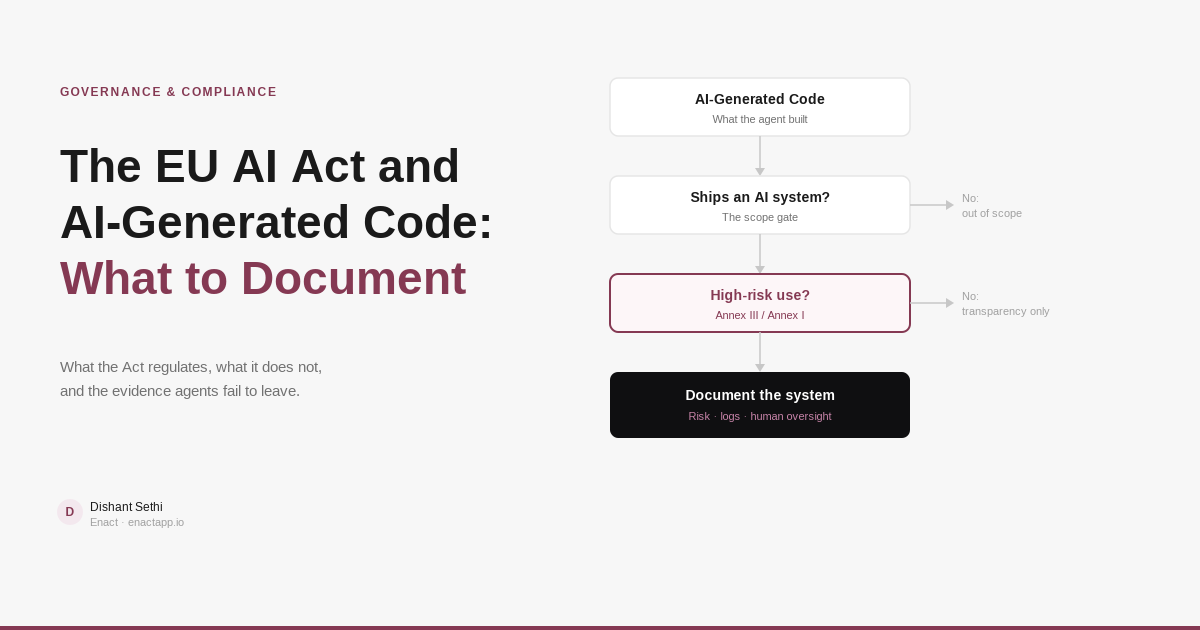
The EU AI Act has changed what careful software development has to prove, and most engineering leaders are reading it backwards. The common worry - "we use AI coding agents, so are we now regulated?" - gets the scope wrong. The Act does not regulate the fact that Cursor, Claude Code, or GitHub Copilot wrote part of your codebase. It regulates the AI systems you place on the EU market, graded by the risk of what they do. The real exposure is narrower, and the documentation duties that come with it are more specific, than the panic suggests.
That specificity is the problem. Where the Act applies, it asks for a record of how a system was designed, why, and who stayed in control - the exact evidence an ungoverned agent workflow does not leave behind.
Key Takeaways
- The tool is not the trigger: Using an AI coding agent does not make your software high-risk. The Act classifies the system you ship by its intended use, not by how the code was written.
- One real trap for engineering orgs: AI used to evaluate or manage developers falls under Annex III (employment). Deploying it can make your own org a deployer of a high-risk system.
- The duties are documentary: For high-risk systems, the Act wants risk management (Article 9), technical documentation (Article 11 and Annex IV), automatic logging (Article 12), and human oversight (Article 14) - all recorded.
- Agent workflows break the paper trail: Annex IV asks you to describe design choices and the development process. When an agent made those choices and nobody logged the human approval, that section cannot be filled honestly.
- The clock moved, the duties did not: The Digital Omnibus pushed the main high-risk deadline to 2 December 2027. The obligations were postponed, not removed.
Does the EU AI Act apply to AI-generated code?
No - not on its own. The EU AI Act regulates AI systems placed on the market or put into service in the EU, classified by risk. Writing ordinary software with an AI coding assistant does not pull that software into scope. What matters is whether the system you ship is itself an AI system, and if so, which risk tier its intended purpose falls into.
This is the distinction that most legal and consultancy coverage blurs, and the one engineering leaders need first. A coding assistant like GitHub Copilot or Claude Code is generally not a high-risk system in itself, because writing, reviewing, or debugging code is not one of the uses the Act singles out. The classification attaches to the product you build and sell, judged by what it is intended to do, not to the IDE you built it in.
So for a large share of teams shipping internal tools, developer platforms, or ordinary SaaS, the honest answer is that the AI Act imposes no new documentation on their AI-assisted development. For teams building AI into regulated use cases, the answer flips hard, and the paperwork is substantial.
The two questions that decide your obligations
Scope under the Act runs through Article 6, which defines two routes to high-risk classification. An engineering leader can resolve their exposure by answering two questions in order.
First: is the thing you ship an AI system you place on the EU market? If you are using agents to build a conventional application with no AI component in the product itself, you are outside the AI Act's system-level duties, whatever your commit history looks like. Governance still matters, but it is not this regulation's concern.
Second: if it is an AI system, does its intended use land in a regulated category? The two cumulative routes are the product-safety route (Article 6(1) and Annex I, covering AI embedded in regulated products such as medical devices and machinery) and the standalone route (Article 6(2) and Annex III, covering uses such as recruitment, credit scoring, education, biometric identification, and critical infrastructure). An Article 6(3) filter can pull a system back out if it does not pose a significant risk to health, safety, or fundamental rights, unless it profiles individuals.
Workflow summary: software built with AI coding agents is only in EU AI Act scope if the shipped product is itself an AI system placed on the EU market. If it is, and its intended use falls in an Annex III or Annex I area, it is high-risk and carries documentation, logging, and human-oversight duties. Otherwise only Article 50 transparency applies, or the system is out of scope entirely.
There is one trap that catches engineering organizations specifically. AI used for employment decisions - evaluating candidates, or managing and monitoring workers, which includes developer performance scoring - sits squarely in Annex III. A team that deploys an AI system to rank its own engineers is a deployer of a high-risk system, with its own obligations, even though the thing it ships to customers is not regulated at all. The regulated system can be the one pointed inward.
What the EU AI Act requires you to document
Once a system is high-risk, AI Act code compliance stops being about disclaimers and becomes about evidence. The core duties are documentary, and they assume you can reconstruct how the system came to be what it is. These are the obligations that apply to the provider of the high-risk system.
| Obligation | Article | What you must be able to produce |
|---|---|---|
| Risk management system | Article 9 | A continuous, documented process that identifies risks and maps each mitigation back to the risk it addresses, maintained across the system's lifetime, not a one-time launch assessment |
| Technical documentation | Article 11 and Annex IV | A record drawn up before the system goes to market and kept current, describing the system, its design choices, and its development process (SMEs may supply a simplified version) |
| Automatic logging | Article 12 | The system logs events over its lifetime for traceability and post-market monitoring |
| Log retention | Article 19 | Those logs are retained for at least six months, longer where sector rules apply |
| Human oversight | Article 14 | Evidence the system is designed so named people can effectively oversee it and understand its limits |
The load-bearing item for anyone using coding agents is Annex IV technical documentation. Its nine sections ask, among other things, for a general description of the system and the design choices behind it, including the development process and the methods used to build it. That is a narrative of decisions: why this architecture, which trade-offs, what was ruled out. It is written on the assumption that the people who made those decisions can account for them.
Article 9 and Article 14 lean on the same assumption from different angles. Risk management (sometimes abbreviated to the AI Act's RMS, a risk management system) has to tie controls to specific, identified risks, which means the risks and the decisions that address them were considered and recorded. Human oversight requires that a person could understand and intervene in the system - and increasingly, that you can show they did. Formalizing who holds that sign-off is the subject of our spec approval workflow guide for AI coding agents.
Where AI coding agents make this documentation hard
Here is the collision. An AI coding agent resolves hundreds of design choices in a single run: data flows, validation boundaries, error handling, library selection. In a conventional team, those decisions are spread across design docs, tickets, and pull request discussion, which is precisely the raw material Annex IV documentation is reconstructed from. When an agent makes them in seconds and opens a clean, passing pull request, that raw material never exists. The pull request records that a diff was merged, not that an accountable person approved the approach the agent took.
So the Annex IV section on design choices and development process has no honest source. The Article 14 human-oversight record has nothing to point to, because the oversight, if it happened, happened in someone's head during a hurried review and was never captured as an event. This is the same provenance gap that makes git history unusable as an audit trail for AI-generated code: the commit proves authorship and timing, not that a human agreed to the plan. Under the AI Act, that gap is not a tidiness problem. It is a missing control.
The failure also compounds through drift. If an agent discovers an unmapped case mid-build and changes course, any earlier approval no longer describes what shipped, and nothing flags the mismatch. Keeping the approved plan and the delivered system in sync is a governance task in its own right, covered in our guide on preventing spec drift when agents work the same codebase. For regulated AI coding, a stale approval is worse than none: it is documentation that misstates what was built.
The compliance timeline engineering leaders are working against
The dates moved in 2026, and a lot of guidance still quotes the old ones. The Digital Omnibus on AI, adopted in mid-2026, amended the application schedule. The main deadline for standalone high-risk systems under Annex III shifted from 2 August 2026 to 2 December 2027, and the deadline for AI embedded in regulated products under Annex I moved to 2 August 2028. Because the dates have shifted once and remain politically live, confirm them against the official AI Act implementation timeline before you plan around any single one.
Two things are worth holding onto through the noise. The obligations were postponed, not repealed: the documentation duties above still arrive, and systems being designed now will be in scope when they ship. And Article 50 transparency duties - telling people when they are interacting with AI or seeing AI-generated content - were not delayed. A deadline that moves is an invitation to defer the paperwork, which is exactly how teams arrive at 2027 with two years of agent-built, undocumented decisions behind them. The cost of reconstructing that record later is the same reason rework compounds when governance is bolted on after the fact. For the enterprise and CISO view of building this into the delivery process, see our enterprise AI SDLC playbook.
A documentation checklist for engineering leaders
Before an AI coding agent contributes to a system that might fall in scope, confirm each item has a durable, contemporaneous record:
- Scope determination on file: A written classification of whether the shipped system is an AI system, and if so, which Article 6 route and Annex applies. Record the reasoning, not just the verdict.
- Internal-use systems counted: Any AI used to evaluate or manage engineers is assessed against Annex III, not assumed to be out of scope because it is internal.
- Design decisions captured at approval: The architectural choices an agent will execute are recorded as an approved plan before the build, giving Annex IV an honest source.
- Named human oversight: A specific person, not a shared account, is recorded as having reviewed and approved the agent's approach, satisfying the Article 14 evidence trail.
- Risk mitigations mapped: Each identified risk is linked to the control that addresses it, as Article 9 requires, and maintained as the system changes.
- Approval version-locked: Editing an approved plan invalidates the approval and forces re-sign-off, so the record never drifts from what shipped.
- Logs retained to the window: Automatically generated logs are kept for at least the six-month floor, longer where your sector demands it.
Most of this is not extra work layered on top of delivery. It is a byproduct of deciding, and recording, who approved what before the agent built it.
Where the documentation comes from
The pattern underneath every one of these obligations is the same: the Act wants proof that a human understood and authorized a system's design, and an autonomous agent workflow does not produce that proof unless the approval is a real, recorded step. You cannot log your way to compliance after the fact. If the decision to let an agent proceed on a given plan happened as a captured, attributed event, the Annex IV narrative, the Article 14 oversight record, and the Article 9 risk mapping largely write themselves, because the decisions and their owners are already on record. If that gate never existed, no documentation tool reconstructs the human judgment an auditor or regulator is asking you to evidence. For software development under the EU AI Act, the task is less about recording what the agent did and more about proving what a person approved.
Build the AI Act paper trail into the plan
Bring a real system and a scope question. We will show how Enact records who approved the agent's plan, and links it to what shipped.
Book a call →