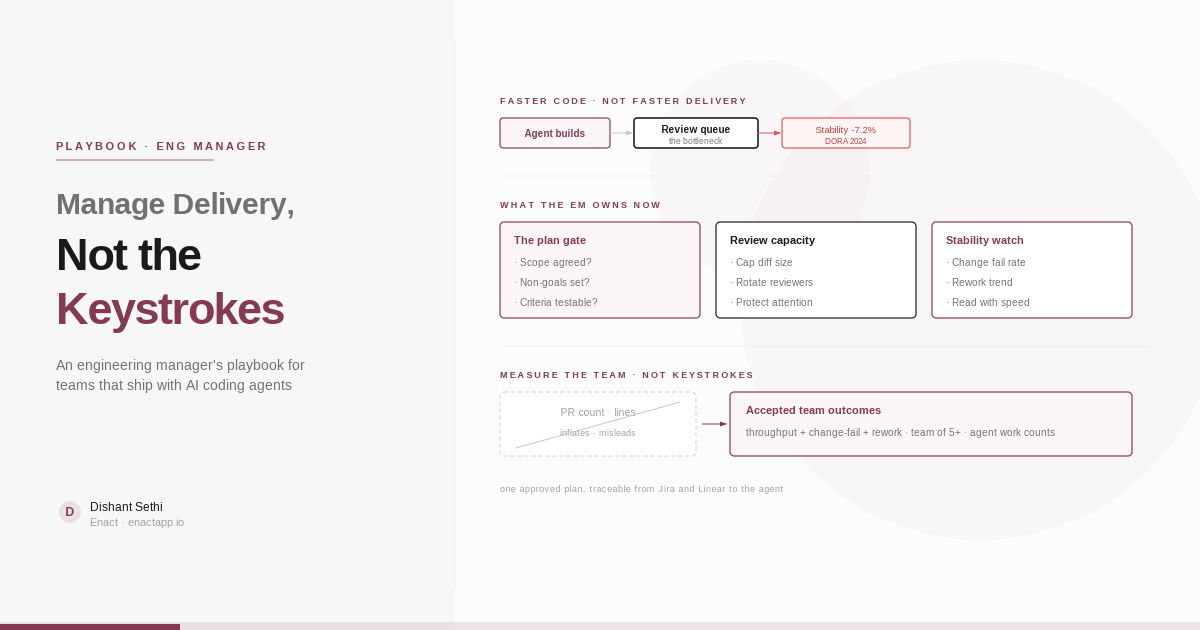
For an engineering manager, AI coding agents change the job before they change the codebase. The team ships features in an afternoon that used to take a sprint, and then three weeks later delivery forecasts stop holding, pull request review becomes the bottleneck, and nobody can say whether the team is actually faster or just busier. The code got quicker. Managing the delivery got harder.
Consider an illustrative scenario common across engineering teams this year. An EM onboards Cursor and Claude Code across a team of six. Output visibly jumps: more PRs, bigger diffs, features closing early. The next planning cycle, two things surface at once. The senior engineers are drowning in review because the agents generate more code than humans can read, and a feature that demoed fine in staging shipped without the migration safety the ticket never spelled out. Velocity went up. Predictability went down.
That trade is not anecdotal. In Google's 2024 DORA report, for every 25% increase in AI adoption, researchers estimated delivery throughput fell about 1.5% and delivery stability fell about 7.2%. Faster individual coding does not automatically produce faster, safer delivery. The gap between the two is exactly what an engineering manager now has to manage.
Key Takeaways
- The leverage moved upstream. When agents write the code, the expensive decisions are the ones made before they start: scope, boundaries, and acceptance criteria. The EM's planning gate matters more than the review gate.
- Review is the new bottleneck. Agents generate more code than a team can carefully read. Unbounded review load is where quality quietly degrades, not in the agent's syntax.
- Measure the team, not the keystrokes. PR count and lines of code inflate under agents and mislead. Track accepted, durable outcomes at the team level, with a minimum team size of five.
- Stability is the number to watch. The DORA signal is that AI adoption can erode delivery stability. Change failure rate and rework are the EM's early-warning metrics.
- One approved plan beats ten good prompts. Delivery planning for agentic teams means freezing intent into a plan the team signs off on, then keeping it traceable as work flows into Jira, Linear, and the agent.
What does an engineering manager actually manage when AI coding agents write the code?
An engineering manager running AI coding agents manages the plan, the review capacity, and the delivery signal, not the typing. The agent authors implementation; the EM owns whether the right work was scoped, whether the team can absorb the review load it creates, and whether delivery is getting faster without getting less stable. Judgment moves upstream of the diff.
AWS makes the same structural point in its agentic lifecycle tooling: the AIDLC delivery agent is described explicitly as "your engineering manager and delivery planner," sequencing work, allocating it, and treating the plan as a living document. Whether you adopt that tooling or not, the role it encodes is the one a human EM now has to fill: delivery planning is a first-class activity, not a side effect of standup.
Workflow summary: Product intent flows into an agent-drafted execution plan. The engineering manager and the team gate that plan before any code is written, sending it back when scope or boundaries have gaps. Once approved, the agent generates code and tests, which pass through bounded human review and into deployment. Team-level delivery metrics feed back to the planning gate, so a drop in stability tightens the plan rather than being discovered in production.
Who owns what: the EM delivery responsibility matrix
The failure mode when managing teams using coding agents is unclear ownership. Engineers assume the EM is watching delivery risk; the EM assumes the agent's output was reviewed; the agent assumes any instruction not written down was not wanted. Set the boundaries before the agent runs, not during the incident review.
| Delivery concern | Engineering Manager | Engineer / Tech Lead | AI Coding Agent |
|---|---|---|---|
| Scope and sequencing of work | Accountable: decides what ships this cycle and in what order | Consulted: flags dependencies and risk | Responsible: drafts the step plan |
| Plan approval before build | Accountable: will not let a build start on an unapproved plan | Responsible: reviews technical approach and blast radius | Responsible: produces the plan to be approved |
| Review capacity | Accountable: caps diff size and protects reviewer time | Responsible: reviews within the cap | Informed: sized to fit the cap |
| Delivery forecasting | Accountable: owns the estimate the business sees | Consulted: validates feasibility | Informed: reports progress against the plan |
| Delivery stability and rework | Accountable: owns change failure rate and rework trend | Responsible: fixes regressions, writes tests | Responsible: implements fallbacks the plan names |
| Team-level metrics and reporting | Accountable: reports outcomes, resists vanity metrics | Informed: sees the same dashboard | Informed: output counted as team output |
Legend: Accountable = signs off and owns the outcome; Responsible = does the work; Consulted = gives input before the decision; Informed = kept in the loop.
This is the delivery counterpart to the plan review that a product manager owns. If PMs are in your loop too, pair this with the PM's guide to reviewing an AI coding agent's plan so product and engineering gate the same plan rather than two disconnected ones.
The agentic delivery playbook: six moves for the engineering manager
1. Make an approved plan the entry condition for any build
The single highest-leverage move is to refuse to let an agent start from a one-line ticket. Require that developers run agents in a read-only planning mode first. Anthropic's Claude Code documentation describes how an agent can explore a repository and emit an explicit implementation plan before touching files. Your rule as EM: no plan, no build. The plan is where scope, non-goals, and acceptance criteria are still cheap to change.
2. Cap review load before it caps your team
Agents generate more code than humans can read with full attention, and unbounded review is where quality silently erodes. Set a working limit on diff size per review (many teams land around 400 lines) and require that anything larger be split or justified. Protecting reviewer attention is a delivery decision, not a style preference.
3. Forecast against the plan, not against output
PR count and lines of code rise under agents whether or not real progress is being made, so they are the wrong basis for a forecast. Sound AI coding agent delivery planning estimates against approved plans and their acceptance criteria: how many are scoped, approved, and in flight. A plan the team signed off on is a far better predictor of a delivery date than a burst of diffs.
4. Watch stability as your early-warning metric
The DORA signal is that AI adoption can pull delivery stability down even as coding speeds up. Put change failure rate and rework rate on the same dashboard as throughput, and read them together. A team closing more tickets while its change failure rate climbs is not getting faster; it is borrowing speed from stability, and that debt comes due in on-call.
5. Count agent work as team work, at the team level
As engineering leaders Gregor Ojstersek and Laura Tacho have argued, PRs authored by agents under a team's direction belong in that team's throughput alongside human-authored ones. Measure at the team level, never per individual: individual AI tracking creates a surveillance culture, erodes trust, and distorts behavior. Keep the unit of measurement a team of five or more.
6. Make the approved plan travel with the work
A sign-off in a chat window is an unversioned vibe. Freeze the approved plan as an execution contract and sync it into Jira, Linear, and the agent's context, so the thing the team agreed on is the thing the agent builds. Keeping that plan synchronized across product intent, engineering review, and agent execution is exactly what Enact was built for, and it is how delivery planning stays honest once agents are in the loop.
Failure modes in agentic delivery, and what the EM must do
The expensive failures are rarely the agent writing broken syntax. They are delivery-level: the things that only show up when you try to plan, review, or ship at team scale.
| Failure mode | What it looks like | What the engineering manager must do |
|---|---|---|
| Review starvation | Two seniors become full-time reviewers; feature work stalls behind the queue. | Cap diff size, rotate review duty, and treat review capacity as a planning constraint. |
| Forecast collapse | Velocity charts spike then whiplash; dates stop being trustworthy. | Estimate against approved plans and acceptance criteria, not PR or line counts. |
| Silent stability debt | Throughput rises while change failure rate and rework quietly climb. | Track stability next to throughput; treat a rising change failure rate as a stop signal. |
| Scope drift mid-build | The agent hits an unforeseen roadblock and improvises scope on its own. | Require the agent to re-request approval instead of silently changing the plan. |
| Context fragmentation | Across multiple repositories, agents miss service boundaries no single prompt carried. | Put cross-repo contracts in the approved plan, not in individual prompts. |
| Unversioned approvals | Nobody can reconstruct who approved what, or whether the build matched it. | Freeze approvals as traceable artifacts synced to Jira or Linear. |
For regulated teams, the last two rows are not just hygiene, they are evidence. Pair this with spec approval workflows for AI coding agents when you need an audit trail, not just a habit.
The engineering manager's agentic delivery checklist
Run this at the start of each cycle, and again whenever delivery metrics wobble:
- Plan gate is enforced: no agent build starts without an approved plan listing scope, non-goals, and acceptance criteria.
- Review load is capped: a per-review diff limit is set, and oversized changes are split or justified.
- Forecast is plan-based: estimates reference approved plans and criteria, not PR counts or lines of code.
- Stability is on the dashboard: change failure rate and rework sit beside throughput, read together.
- Metrics are team-level: agent output counts as team output, aggregated to teams of five or more, never per individual.
- Approvals are traceable: every sign-off is a versioned artifact synced to Jira or Linear, not a chat message.
Before the next cycle, quantify what unplanned rework is already costing the team with the rework cost calculator, and bring that number to the planning conversation. It reframes the plan gate from process overhead into the cheapest insurance the team has.
Managing delivery, not keystrokes
The instinct when AI coding agents arrive is to manage the output: more dashboards, more PRs counted, more throughput celebrated. That instinct is the trap the DORA data warns about. Output is the one thing agents already make abundant. What stays scarce, and what the engineering manager now owns, is a plan the team agrees on, review capacity that is not overrun, and a delivery signal that tells the truth about stability.
Managing teams using coding agents well is less about adopting another tool and more about moving the manager's judgment to where it still changes the outcome: upstream of the build, at the plan. A code diff is a record of decisions already made. A plan is a proposal you can still steer. The EMs who come out ahead are the ones who gate the plan, bound the review, and watch stability, rather than watching the line count climb.
Keeping that approved plan synchronized between product intent, engineering review, and agent execution across Jira and Linear is what Enact was built to do.
Plan delivery before the agent builds
The enterprise AI SDLC playbook shows engineering managers how to gate the plan, bound review, and keep every approval traceable as coding agents ship.
Download the playbook →